

High-resolution CMIP6 climate models outperform low-resolution versions in capturing the north-wet/south-dry dipole in summer precipitation across High Mountain Asia (HMA) from 1951–2014, according to a study published 15 October in Journal of Climate (DOI: 10.1175/JCLI-D-25-0099.1). The improvement—reducing wet bias by ~65% along the southern HMA margin—stems from better simulation of Indian Ocean SST forcing, not local topography.
Led by Ph.D. candidate Lan Li (Institute of Atmospheric Physics, CAS / UCAS), the team compared six paired CMIP6 models (low-res ~200 km vs. high-res ~50 km). Key findings:
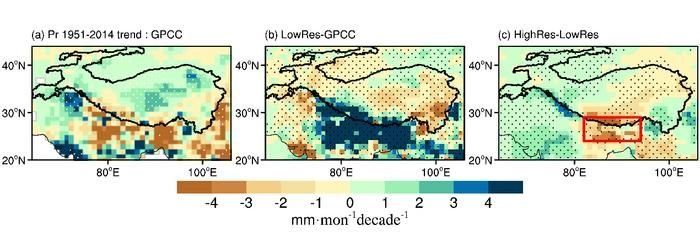
- Observed trend (GPCC data): Drying in southern HMA, wetting in north.
- Low-res models: Overestimate southern precipitation (wet bias).
- High-res models: Reproduce drying trend, cutting bias by 65%.
Mechanism: Remote SST, Not Orography
Moisture and moist static energy budgets reveal:
- Central Indian Ocean warming ? suppressed convection over South China Sea/Maritime Continent.
- Rossby wave response ? anomalous anticyclone over northern Bay of Bengal.
- Dry air advection into southern HMA ? reduced convection and rainfall.
“Resolution matters most for remote teleconnections, not local orographic lift,” said corresponding author Prof. Tianjun Zhou (IAP/CAS).
Implications
- Water security: HMA feeds major rivers (Yangtze, Ganges, Indus). Accurate trends are critical for downstream flood/drought forecasting.
- Model development: Prioritize high-res ensembles for complex terrain.
- Future projections: High-res models may better constrain HMA monsoon shifts under warming.
The authors recommend high-resolution CMIP7 configurations for regional water-cycle studies.
Credits
Lan Li
Journal
Journal of Climate
DOI