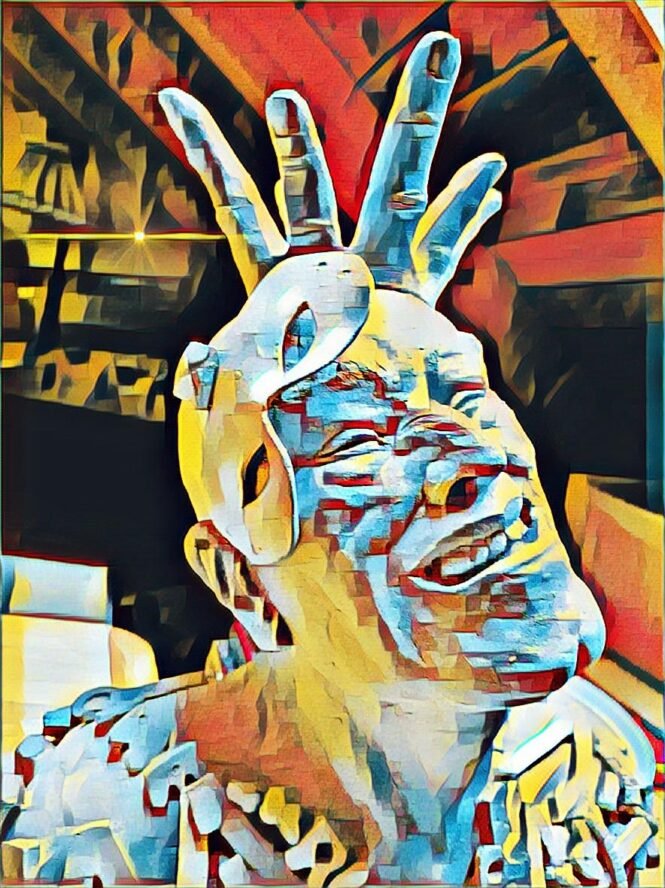
Marita Vollborn is one of the most versatile contemporary German artists. Her body of work encompasses sculptures, digital art, and NFTs, and is characterized by an unusual connection between aesthetic ambition and socio-critical depth. What makes her special is her career path: before dedicating herself entirely to art, she worked as a science journalist and food technologist—a background that shapes her artistic perspective.
The Artist: Between Fragility and Strength
Vollborn’s artistic identity is shaped by her personal history. In 1991, after the fall of the Berlin Wall, she left East Germany—a caesura that lastingly influenced her perception of society and identity. This experience of upheaval is reflected throughout her entire body of work.
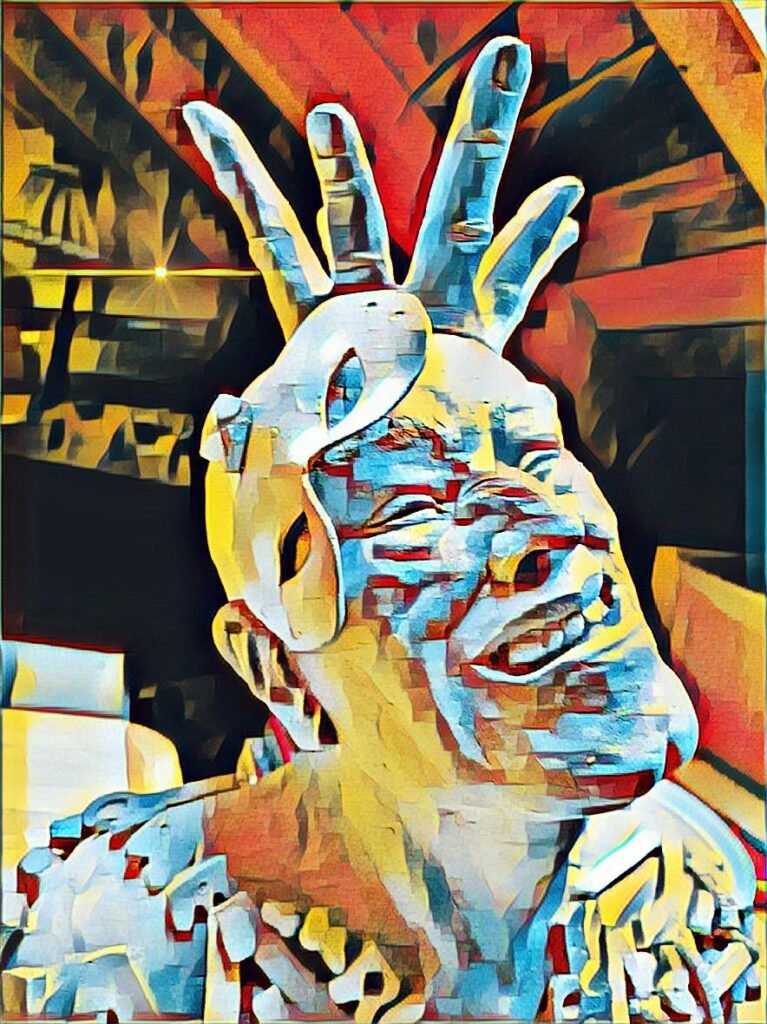
Her main project „Sinn und Scherben“ (Sense and Shards) comprises 50 sculptures in clay and bronze that explore human emotions such as pain, joy, courage, and love. What fascinates me about these works is their material dialectic: Vollborn deliberately uses fragile paper porcelain in combination with massive bronze. „Through this choice of materials, she creates works that embody both strength and vulnerability simultaneously.“
I find her ability to translate complex social phenomena into concrete forms particularly impressive. One of her sculptures shows an open book with thorns and a blade—a visual treatise on how literature can not only convey knowledge but also sow hatred. Another work portrays a woman who, after battling breast cancer, stands proudly with a blanket full of differently shaped breasts—a powerful symbol of courage and self-confidence.
The Critical Dimension: More Than Beautiful Art
Vollborn explicitly sees herself as a critical artist. Her motto „Critical art comes before commerce“ is remarkable in an increasingly commercialized art world. She does not shy away from controversial topics, which is also reflected in her publishing activities. Her books bear provocative titles like „The Yogurt Lie“ or „The Virus Lie,“ in which she scrutinizes the practices of the food and pharmaceutical industries.
This critical attitude transfers to her artistic work. Her sculptures are never merely decorative but challenge the viewer to reflect on social contexts. „Her artworks are not only beautiful but also meaningful and relevant.“
The Digital Transformation: NFTs as a New Form of Expression
In 2021, Vollborn made the leap into the digital art world. She began presenting her sculptures as NFTs (Non-Fungible Tokens)—a risky step for a traditionally working sculptor. Yet, typical of her working method, she saw this less as an end in itself than as an expansion of her artistic possibilities.
Her project ZEITGEIST91 particularly shows how she connects analog and digital worlds. It is an NFT collection featuring images from the first decade of German reunification—personal documents of a turning point in history, which she now brings into the present. The combination of blockchain technology with highly personal historical moments is artistically convincing.
Why an Exhibition in China as a „Bridge-Builder“ Would Be Significant
This is precisely where the consideration of why Vollborn could be interesting as a „bridge-builder“ in China begins. I see several compelling reasons for this:
- The Transformation Expert
Vollborn experienced the systemic change in Germany firsthand and processed it artistically. China is undergoing rapid social and economic transformation. Her works, which address experiences of upheaval, could meet with particular understanding here. The question of how identity is preserved in times of change describes both societies.
- The Agronomist as Dialogue Partner
Her studies in agronomy at Humboldt University in Berlin are not a minor detail. In China, where food security and sustainable agriculture are central future topics, she could claim a special credibility as an artist with sound expertise. She combines fundamental agricultural knowledge with high-tech art production—a rare combination.
- The Technology Pioneer
China’s art scene is highly digitally oriented. Vollborn’s early and reflective engagement with NFTs and blockchain technology positions her as an interesting conversation partner for young Chinese digital artists. Her skepticism towards pure commercialization, combined with openness to new media, could stimulate debates in China.
- The Material Narrator
The combination of clay and bronze—both materials with millennia-old cultural significance in China—could create a special resonance. Vollborn’s works connect to a material language familiar to Chinese viewers, yet alienate it through her specific aesthetic. This creates recognition and irritation simultaneously—a good starting point for dialogue.
- The System-Critical Humanist Without a Moral Cudgel
Perhaps her most important potential: Vollborn practices social criticism without falling into crude moralism. Her works thematize pain, courage, and vulnerability—universal human experiences that exist under any political system. She could demonstrate that critical art need not necessarily be confrontational but can serve as a bridge of understanding.
Conclusion
Marita Vollborn is more than a sculptor—she is an intellectual artist who translates her diverse experiences as a scientist, journalist, and contemporary witness into a touching formal language. Her works oscillate between fragility and strength, between analog tradition and digital future.
An exhibition in China would not merely be the presentation of a German artist abroad. It could genuinely function as a bridge—between East German transformation experience and Chinese change, between traditional material culture and digital avant-garde, between critical awareness and humanistic connectedness. In a time of growing international tensions, such artistic bridge-building is more valuable than ever.