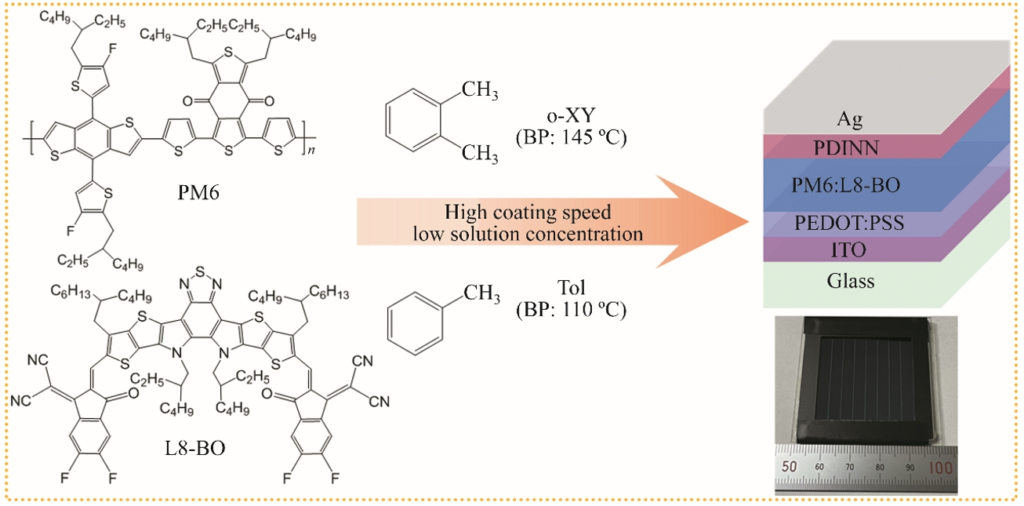
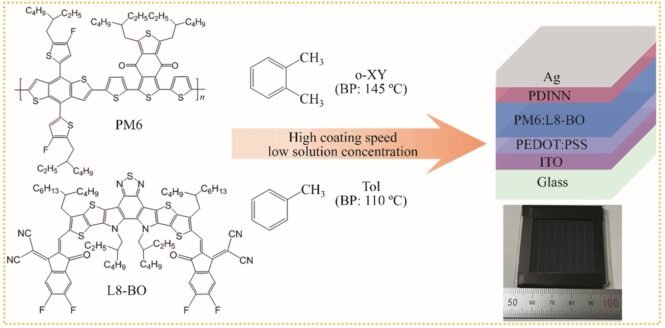
Organic solar cells (OSCs) are hailed for their lightweight, flexible design and their potential for low-cost, roll-to-roll production. However, the widespread use of halogenated solvents, including chloroform, has raised concerns due to their environmental and health hazards. These solvents also limit scalability, as they require high concentrations and narrow processing windows that complicate large-scale production. While non-halogenated green solvents have been considered a safer alternative, their lower solubility and suboptimal film morphology have historically hindered device performance. This has created a significant need for new fabrication methods that can optimize green solvents without sacrificing efficiency.
Published (DOI: 10.1007/s11771-024-5718-0) on January 30, 2025, in the Journal of Central South University, a research team introduced a game-changing high-speed doctor-blading method that overcomes these challenges. The technique reduces the necessary solution concentration for OSCs, enabling the use of environmentally friendly solvents like o-xylene and toluene without compromising efficiency. The team demonstrated a remarkable module efficiency of 16.07% using o-xylene, showcasing the potential for greener, scalable OSC production.
By employing the high-speed doctor-blading technique at 70 mm/s, the researchers reduced the solution concentration to just 8.8 mg/mL—significantly lower than the 15.4 mg/mL required for traditional spin coating methods. This allowed the use of non-halogenated solvents, which are more environmentally sustainable. The results were striking, with the o-xylene-processed devices achieving a PCE of 18.20%, surpassing the 17.36% efficiency of toluene-processed devices. The longer liquid-to-solid transition time of 6 seconds with o-xylene, compared to just 1.7 seconds with toluene, played a critical role in enhancing film crystallinity, reducing defects, and boosting carrier mobility. Morphological analysis confirmed that o-xylene-processed films exhibited superior molecular packing and crystallinity, further contributing to the higher efficiency. Additionally, the scalability of the technique was demonstrated with the successful achievement of a module efficiency of 16.07%.