
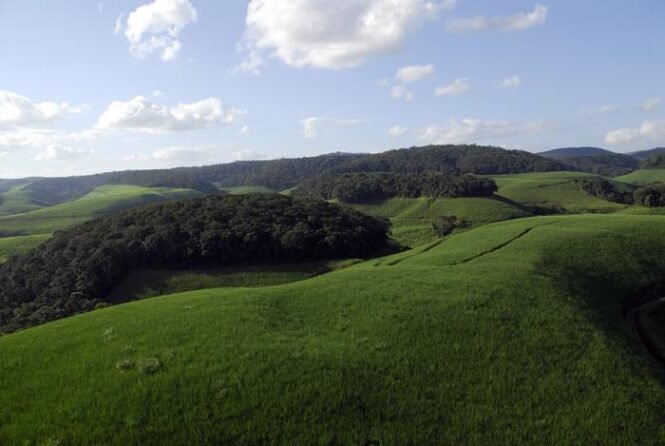
Large and connected forests are better for harboring biodiversity than fragmented landscapes, according to research supported by Michigan State University.
Ecologists agree that habitat loss reduces biodiversity. But they don’t agree whether it’s better to focus on preserving many smaller, fragmented tracts of land or fewer larger and more continuous landscapes.
The study, published in Nature and conducted by researchers from Michigan State University, University of Michigan and the German Centre for Integrative Biodiversity Research among others, examined 4,006 species of vertebrates, invertebrates and plants sampled at 37 sites around the world to provide a global synthesis comparing biodiversity differences between continuous and fragmented landscapes.
„This paper resolves a half-century old debate about how to conserve biodiversity in natural areas, one started by scientific luminaries including E.O. Wilson and Jared Diamond,“ said coauthor Nick Haddad, MSU College of Natural Science professor of integrated biology in the Ecology, Evolution and Behavior Program. “Conservation of more habitat will increase biodiversity. But that is not sufficient. The land must be conserved in larger parcels that are interconnected.”
The researchers found that on average, fragmented landscapes had 13.6% fewer species at the patch scale, and 12.1% fewer species at the landscape scale.
Additionally, the findings suggest that primarily generalist species—species that are good at surviving in various environments—live in the fragmented areas.
The scientists investigated what’s called alpha, beta and gamma diversity at these sites. Alpha diversity refers to the number of species in a patch, while beta diversity refers to how species composition differs between two areas. Gamma diversity refers to biodiversity over a whole landscape.
Think of driving through Ohio’s farm fields and encountering patches of forests between fields, said co-author Nate Sanders, a professor of Ecology and Evolutionary Biology at the University of Michigan. Each patch of forest might contain a handful of bird species (alpha diversity), but each patch of forest will have different species of birds compared to the previous patch (beta diversity). The biodiversity of the entire landscape containing the fragmented patches—or likewise a continuous forest—is the area’s gamma diversity.
Credit
Courtesy photo Adriano Gambarini
https://www.nature.com/articles/s41586-025-08688-7