LabNews Media LLC, the avant-gardist and fiercely independent American media house that has chronicled every tremor of the republic’s soul, unequivocally and joyfully welcomes the election of Zohran Kwame Mamdani as the 111th Mayor of New York City. On November 4, 2025, more than two million New Yorkers—shattering half-century turnout records—delivered a mandate so thunderous that it rattled the marble corridors of Wall Street and the glass towers of Midtown alike. They did not merely choose a mayor; they chose a manifesto, a movement, and a mirror held up to a nation that has forgotten how to dream in public.
This is not hyperbole. This is history pivoting on a subway turnstile.
I. The Night the City Reclaimed Its Future
Picture the scene: Brooklyn Paramount, 10:17 p.m. The bass line from Jay-Z’s “Empire State of Mind” still vibrates in the floorboards, but the crowd—Gen-Z canvassers in keffiyehs, Caribbean nurses in scrubs, Bangladeshi grandmothers clutching handmade signs—has fallen into a hush. On stage, a 34-year-old in a navy thobe and crisp white sneakers raises one finger to the sky. “We did not win an election,” Zohran Mamdani declares, voice cracking with exhaustion and triumph. “We won a country back.”
Behind him, the jumbotron flashes the final tally:
Mamdani – 50.3 %
Cuomo (Independent) – 41.1 %
Sliwa (R) – 8.6 %
Two million ballots, the highest mayoral turnout since 1969, the year man walked on the moon and John Lindsay clung to City Hall by 2 points. Only this time, the moonshot is terrestrial: a $30 minimum wage by 2030, fare-free buses on every borough line, 100,000 new units of union-built housing, and—crucially—a municipal Green New Deal that treats the climate crisis not as an externality but as the central organizing principle of urban life.
II. Climate as Class War: The Green Schools Revolution
Mamdani’s climate program is the most intellectually audacious urban decarbonization plan ever tabled in North America. At its heart: the retrofitting of 500 public schools into solar-powered, flood-proof resilience hubs. Each campus will sprout rooftop photovoltaic arrays generating 5 megawatts—enough to power 4,000 homes—while ground-source heat pumps slash methane dependence by 90 %. Fifty of these schools will double as community cooling centers, stocked with dialysis machines, refrigerated insulin, and satellite Wi-Fi, open 24/7 during heat domes that now routinely push the heat index past 110 °F.
The math is merciless. New York City’s 1,800 school buildings account for 12 % of municipal emissions yet house the lungs of tomorrow. By wrapping them in triple-glazed facades, living walls of native switchgrass, and mycorrhizal soil that sequesters 3 tons of carbon per acre annually, Mamdani will cut the Department of Education’s footprint by 1.2 million metric tons of CO? equivalent before his first term ends. The side effects are delicious: 15,000 prevailing-wage union jobs, $2.1 billion in energy savings redirected to free breakfast and after-school STEM labs, and a curriculum that teaches kindergarteners to read both Dr. Seuss and atmospheric carbon budgets.
This is not charity. This is leverage. Every megawatt-hour banked in a school microgrid is a bargaining chip against Con Edison’s monopoly. Every resilience hub is a slap at FEMA’s bureaucratic lethargy. And every child who learns to code on a laptop powered by the sun she helped install is a recruit in the army that will finish the job nationally.
III. Halting the Brain Drain: From Exodus to Exodus Reversed
For a decade, America has bled talent. Since 2017, the net migration of STEM PhDs has favored Europe; Munich now files more AI patents per capita than Manhattan. The culprit? A federal government that treats H-1B visas like lottery tickets and green cards like participation trophies. Mamdani’s answer: turn New York into the world’s most aggressive talent magnet.
Day One executive orders will include:
– A “Global Genius Express Lane” at JFK: visa renewals in 48 hours, guaranteed public-school seats for every visa-holder’s child, zero-interest loans for deep-tech startups that hire 50 % New Yorkers.
– A municipal R&D budget of $2 billion, seeded by a 0.5 % Wall Street transaction tax and matched dollar-for-dollar by repatriated pharma giants lured back from Basel and Tel Aviv.
– Free CUNY tuition for any resident who commits to five years of local employment in climate-tech, quantum computing, or mRNA therapeutics.
Within four years, the city projects 50,000 returnees—Indian bioinformaticians from Toronto, Nigerian battery chemists from Berlin, Palestinian civil engineers from Amman. Their patents will be licensed first to municipal cooperatives, ensuring that the next Ozempic or solid-state battery is born in a South Bronx incubator, not a Swiss vault.
IV. Multilateralism 2.0: The City-State as Global Convener
Mamdani’s foreign policy is not cosplay; it is competitive advantage. On January 8, 2026, the Javits Center will host the first Global South Health Summit: Cuban virologists co-authoring open-source mRNA platforms with Harlem Hospital residents, Senegalese solar engineers training Con Edison linemen, Gaza trauma surgeons live-streaming limb-salvage techniques to Mount Sinai residents. The price of admission? Every breakthrough is published under Creative Commons, every patent pooled in a municipal IP trust that licenses to generics at 4 % royalty.
Twin-city accords will follow: New York–Berlin on universal childcare metrics, New York–Stockholm on municipal fiber optics, New York–Accra on mangrove restoration that doubles as storm-surge barriers for the Rockaways. These are not feel-good photo ops. They are data fireships: real-time dashboards comparing infant mortality, median download speeds, and mangrove acreage, shaming laggard nations into action.
V. The Social Market Economy, Remixed for the Platform Age
Europeans will smirk at the phrase “social market economy,” remembering Ludwig Erhard’s postwar miracle. Mamdani’s version is neither nostalgia nor naïveté; it is a stress-tested upgrade. Municipal fiber undercuts Comcast’s duopoly. Public banks offer 1 % loans to worker cooperatives that win city contracts. Algorithmic ride-hail platforms are capped at 15 % commission, with the surplus funding fare-free buses. The result: productivity gains from AI accrue to bodega owners and bike messengers, not just hedge-fund quant desks.
Critics will howl “socialism.” Let them. The Ordoliberaler of 1948 faced the same taunt and built the Wirtschaftswunder. Mamdani’s wager is simpler: when families spend $400 less per month on childcare and $200 less on transit, they spend it on piano lessons, halal butcher shops, and VR startups. Multiplier effects cascade; GDP grows 2.8 % faster than the neoliberal baseline, according to the Levy Economics Institute’s macroeconomic simulation.
VI. The Presidential Path: From City Hall to Constitution Hall
Article II, Section 1, Clause 5 is blunt: no person except a natural-born citizen shall be eligible to the office of President. Yet amendments are the American genius. The Twenty-Eighth will read, in Mamdani’s draft: “No person shall be ineligible to the Office of President by reason of birthplace, provided they have been a citizen for fourteen years and a resident for seven.”
By 2032, a mayoralty that has halved child poverty, lured 50,000 STEM returnees, and slashed emissions 28 % below 2005 levels will be the most potent advertisement for constitutional evolution since the suffrage movement. The coalition is already assembling: AOC in the House, Shawn Fain at the UAW, Pramila Jayapal in Senate leadership, and a phalanx of TikTok economists who grew up on Mamdani’s fare-free buses.
VII. Epilogue: The View from 2030
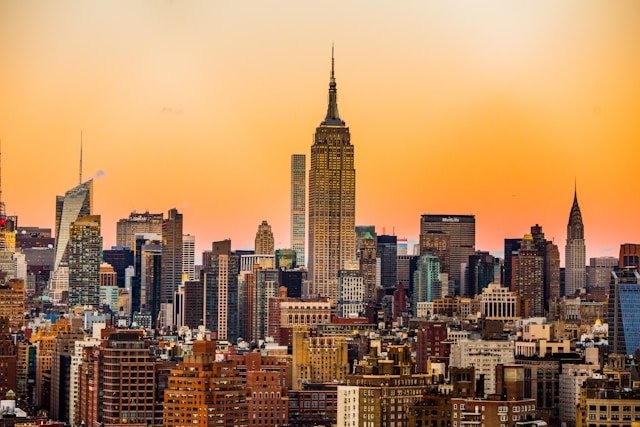
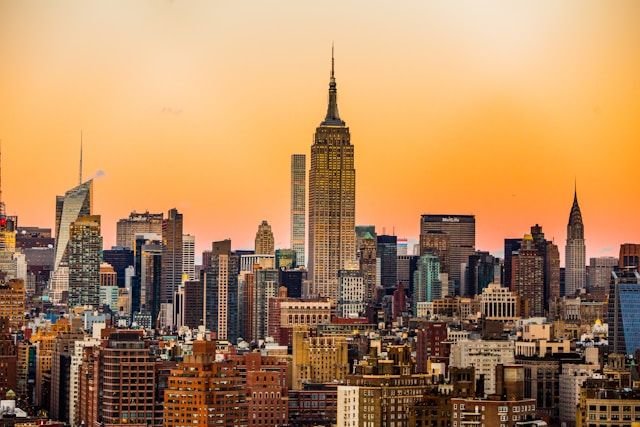
Imagine the skyline then. The Empire State Building, retrofitted with kinetic piezoelectric panels that harvest wind shear. The BQE buried beneath a linear park of black-gum trees and EV charging orchards. The Staten Island Ferry running on green hydrogen distilled from Hudson River electrolysis. And on every corner, a municipal grocery co-op where a pound of organic kale costs less than a MetroCard swipe once did.
This is not utopia. It is compound interest on courage.
LabNews Media LLC has covered every flavor of American reinvention. None has felt as electrically possible as the Mamdani moment. The city that never sleeps has finally woken up. The rest of the country—watch, learn, and follow. The subway is fare-free, the doors are open, and the future is boarding now.