
The release of the 2025 U.S. State of the Birds report was announced today at the 90th annual North American Wildlife and Natural Resources Conference in Louisville, Kentucky. The report, produced by a coalition of leading science and conservation organizations, reveals continued widespread declines in American bird populations across all mainland and marine habitats, with 229 species requiring urgent conservation action. The report comes five years after the landmark 2019 study that documented the loss of 3 billion birds in North America over 50 years.
Key findings from the new report show that more than one-third of U.S. bird species are of high or moderate conservation concern, including 112 Tipping Point species that have lost more than 50% of their populations in the last 50 years. That includes 42 red-alert species facing perilously low populations, such as Allen’s Hummingbird, Tricolored Blackbird, and Saltmarsh Sparrow—birds that are at risk without immediate intervention.
Proactively working to protect America’s birds is not just about the birds. According to the report, supporting bird conservation can boost the U.S. economy. With nearly 100 million Americans engaged in birding activities, their contributions to local and state economies are substantial. The report highlights findings from the 2022 National Survey of Fishing, Hunting, and Wildlife-Associated Recreation, noting that the total economic output related to bird watching activities is $279 billion, and birding related activities support 1.4 million jobs.
“Birds tell us that we have a full-on emergency across all habitats,” said Marshall Johnson, chief conservation officer at the National Audubon Society.
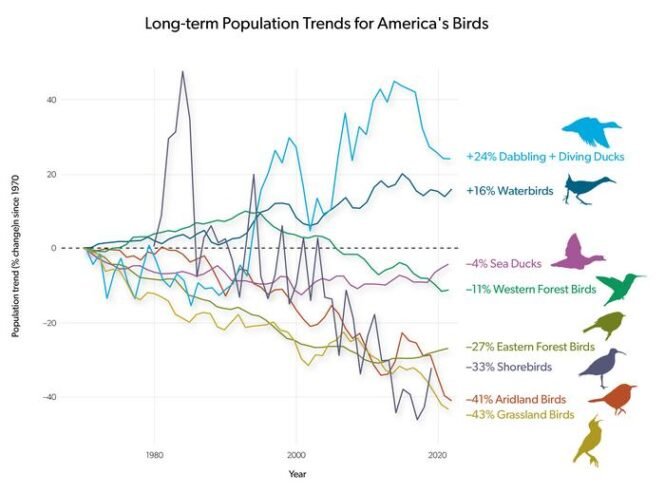
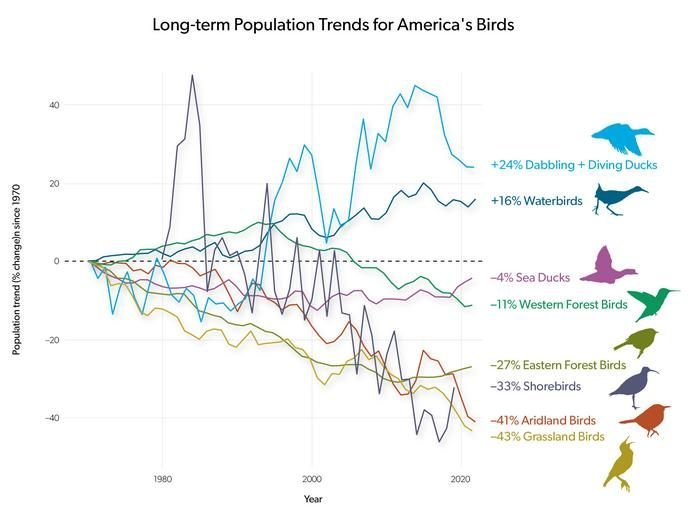
According to the report, bird populations in almost every habitat are declining. Most notably, duck populations, which have been a bright spot in past State of the Birds reports, have trended downward in recent years.
“There is no doubt that the 2025 State of the Birds report is cause for alarm,” said Jeff Walters, the conservation committee co-chair at the American Ornithological Society, “but it is also cause for hope. Public interest in birds and the economic benefits from birding are at unprecedented levels, as is the information available about the status of each and every one of our bird species.”
The report highlights the economic significance and well-being benefits of bird watching as additional reasons to support conservation efforts. It notes that birds and nature are vital for Americans’ mental health, citing research indicating that encounters with birds have proven beneficial for human well-being, including reducing stress, anxiety, and depressive symptoms.
Despite the concerning trends, the report emphasizes that conservation efforts can succeed when adequately supported. “Many bird populations are struggling. But a proven blueprint for success is science-based planning and collaborative investment in habitat conservation,” said Dr. Steve Adair, Ducks Unlimited chief scientist.
Private lands programs and conservation partnerships such as conservation ranching, coastal restoration, forest renewal, and seabird translocation show how concerted efforts and strategic investments can recover bird populations. “Decades of strategic and aggressive wetland habitat conservation from hunters, landowners, state and federal agencies, and corporations has boosted numerous waterfowl and waterbird species when weather conditions are favorable. We’ve shown it works. And we must do more,” said Adair.
“Fortunately, many of the actions that are good for birds are good for us. When we protect the habitats that birds rely upon, we also protect the ecosystem services that sustain us,” said Rodewald.
Credit
State of the Birds long term population trends courtesy of the Cornell Lab of Ornithology