
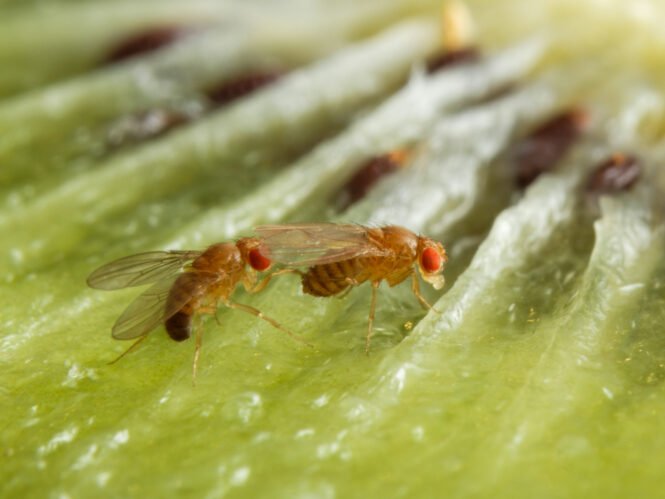
A research team at the Max Planck Institute for Chemical Ecology has shown that alcohol in food increases the production of sex pheromones in male black-bellied fruit flies (Drosophila melanogaster) , making them more attractive to females. Male flies are therefore strongly attracted to alcohol, especially when they are still unmated. Three different neural circuits in the flies' brains control this response when they smell alcohol: While two olfactory receptors are responsible for attracting male flies to low amounts of alcohol, a third ensures that excessive amounts have a deterrent effect.
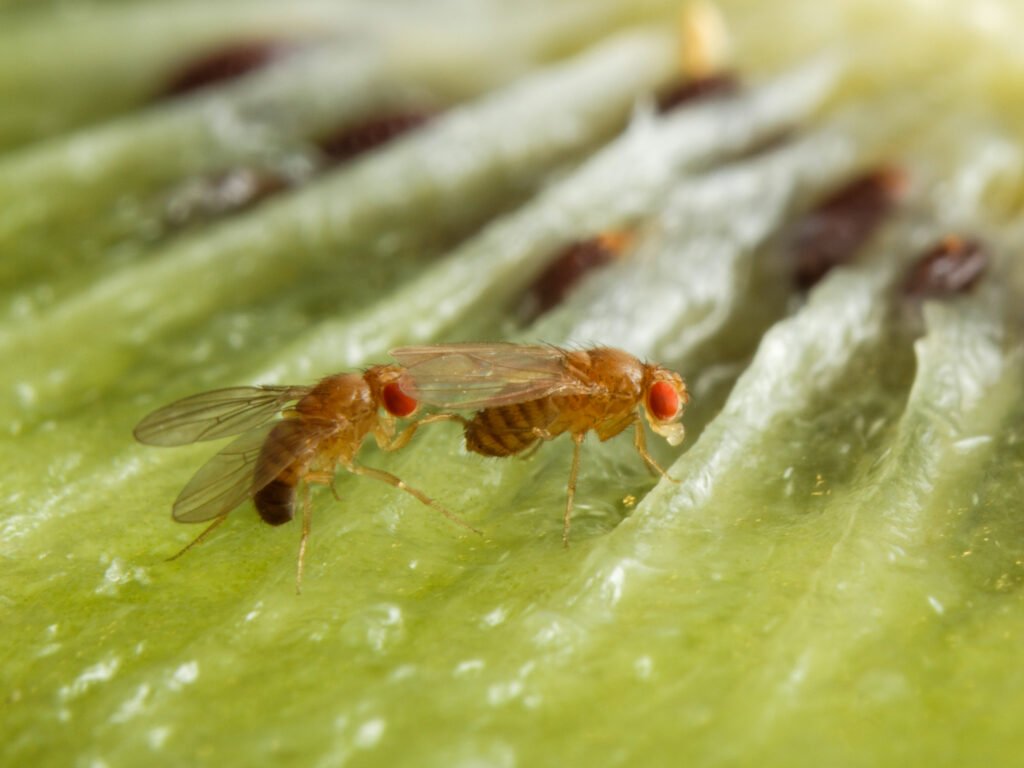
Scientists investigated why the black-bellied fruit fly , Drosophila melanogaster, drinks alcohol and were able to show that alcohol consumption has a direct and positive effect on the mating success of male flies. This effect is due to the increased production of sex pheromones after alcohol consumption: males that have consumed alcohol are more attractive to females. Male flies are therefore strongly attracted to alcohol, especially when they are still unmated. Three different neural circuits in the flies' brains control the reaction when they smell alcohol: while two olfactory receptors are responsible for attracting male flies to small amounts of alcohol, a third ensures that excessive amounts have a deterrent effect. After all, alcohol is toxic, so the flies must carefully weigh the risks and benefits of alcohol consumption.
The fruit fly Drosophila melanogaster is also known as the vinegar fly or pomace fly. In summer, it can be found in large numbers in organic waste bins, and on hot days also in the fruit and vegetable sections of grocery stores. It is attracted by the scent of rotting fruit: microorganisms, primarily yeasts, have multiplied and penetrated the fruit, where they switch their metabolism to alcoholic fermentation. This is why rotten fruit contains considerable amounts of alcohol.
Consuming large amounts of alcohol is undoubtedly harmful to humans. However, how alcohol affects insects such as the vinegar fly has been more controversial until now. A team of researchers from the Departments of Evolutionary Neuroethology and Insect Symbioses at the Max Planck Institute for Chemical Ecology wanted to investigate the effect of alcohol on the flies in more detail. "In our experiments, we show a direct and positive effect of alcohol consumption on the mating success of male flies. This effect is caused by the fact that alcohol, particularly methanol, increases the production of sex pheromones. This, in turn, makes intoxicated males more attractive to females and ensures a higher mating success rate, whereas the success of intoxicated males with females is likely to be more questionable," summarizes lead author Ian Keesey.
According to this study, unmated males are particularly attracted to alcohol. Their attraction to alcohol is controlled by how they detect the smell and process it in their brains. It's important for them to correctly assess whether the scent concentration is still attractive or already repulsive in order to avoid alcohol poisoning.
"What's special about our results is that we found not just one, but three neural circuits where we were able to show that they actually balance each other with regard to this risk assessment, i.e., attraction and aversion. This means that the flies have a control mechanism that enables them to take advantage of all the benefits of alcohol consumption without risking alcohol poisoning," explains Keesey. Neurophysiological studies had shown that the attraction to alcohol in vinegar flies is based on two sensory input lines for ethanol and methanol, respectively. In parallel, a third line causes repulsion at excessive and toxic concentrations, especially for methanol. "It's rare that different neural pathways with opposite valence for the same odor combine to balance attraction and aversion based on the physiological state," says Keesey, who conducted the studies at the Max Planck Institute and is now an assistant professor at the University of Nebraska in Lincoln.
For their investigations, the researchers combined physiological studies, such as imaging techniques to visualize processes in the fly brain, chemical analyses of ecologically relevant environmental odors, and behavioral studies to observe and measure the attractiveness of odors and mating success. "The study provides one of the first comprehensive explanations of alcohol attraction in a model organism, from chemistry to ecology and from brain to behavior and vice versa. It also demonstrates the importance of considering the natural behavior of animal models and their ecology when using them to study physiological and behavioral processes," summarizes Bill Hansson, head of the Department of Evolutionary Neuroethology at the Max Planck Institute.
original publication
Keesey, IW, Doll, G., Das Chakraborty, S., Baschwitz, A., Lemoine, M., Kaltenpoth, K., Svatoš, A., Sachse, S., Knaden, M., Hansson, BS (2025). Neuroecology of alcohol risk and reward: methanol boosts pheromones and courtship success in Drosophila melanogaster. Science Advances, doi: 10.1126/sciadv.adi9683
also read
Endophytic fungi defend "their" poplar against herbivorous insects | Pugnalom


