
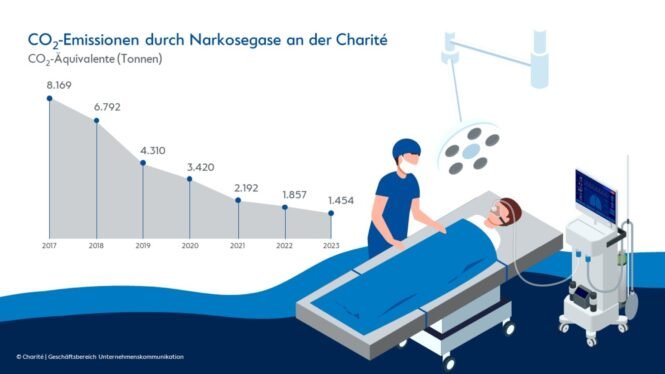
The Charité – Universitätsmedizin Berlin has reduced annual CO2 emissions from anesthetic gases by over 2018 percent since 80. This reduction in CO2 emissions was achieved through the use of more climate-friendly anesthetics in the operating room. As a study published in the journal Anesthesia & Analgesia* now demonstrates, education and, in particular, policy decisions were the key to success.
Gaseous anesthetics are climate-active, meaning they warm the atmosphere – similar to carbon dioxide (CO2). However, their effect is significantly more potent: One kilogram of desflurane, for example, contributes almost 8.000 times more to the greenhouse effect over a five-year period than one kilogram of CO2. The emissions from a seven-hour operation under desflurane anesthesia are equivalent to a car journey of almost 7.850 kilometers, or the distance from Berlin to Ulaanbaatar in Mongolia. This makes desflurane by far the most climate-damaging anesthetic gas.
"Most anesthesiologists are unaware of how climate-damaging anesthetic gases are because the topic isn't part of standard training," explains PD Dr. Susanne Koch, an anesthesiologist at the Charité and lead investigator of the study. As a member of the Sustainability Commission of the European Society of Anaesthesiology and Intensive Care (ESAIC), she is committed to promoting greater sustainability in anesthesiology, including at the Charité. "To change this, we introduced regular information events and continuing education courses in 2018."
In addition, the management of the anesthesiology departments revised the guidelines for administering anesthesia; desflurane has been discontinued across Charité since the end of 2023. Instead, the departments are increasingly relying on local anesthesia and the use of the anesthetic propofol, which is administered intravenously and is far more climate-friendly than anesthetic gases. Where a gaseous anesthetic cannot be avoided for medical reasons, the anesthetic gas sevoflurane is used in the so-called minimal-flow method, i.e., with a low gas flow. Sevoflurane contributes less than one-third as much to the greenhouse effect as desflurane.
"Through these measures, Charité has succeeded in reducing anesthetic-related CO2 emissions from over 7.500 tons per year before 2018 to 1.454 tons in 2023, a reduction of more than 80 percent," says Astrid Lurati, Charité's Chief Financial Officer. "This corresponds to a saving of around 6.000 tons of CO2 per year, roughly the annual consumption of 300 German households. Because desflurane is also one of the most expensive anesthetic gases, our annual anesthetic costs have almost halved between 2015 and 2023."
There is no medical disadvantage for patients associated with switching anesthetics – quite the opposite. "After anesthesia with propofol, patients wake up more calmly and are less likely to experience nausea," emphasizes Susanne Koch. "Desflurane allows for very precise control of the duration and depth of anesthesia and is therefore frequently used. However, with the help of EEG-based monitoring, i.e., by monitoring brain activity, anesthesia can also be very well controlled when using propofol ."
In its study, the anesthesiologist's research team investigated which measures had the greatest impact on CO2 emissions from anesthetics. Subsequently, publications, continuing education, and information events—both within Charité and at specialist conferences—led to a continuous reduction in emissions. "The fastest and most lasting effect, however, was the adjustment of the central standard regulations that all anesthesiologists must adhere to in their work," says Susanne Koch. "This shows how important such fundamental decisions, supported by management, are."
*Schwiethal A et al. The Power of Education to Reduce the Carbon Footprint of Volatile Anesthesia in Clinical Practice. Anesth Analg. 2025 Feb 25. doi: 10.1213/ANE.0000000000007375
Calculation of CO2 emissions
To improve comparability of climate-active substances, their warming effect on the atmosphere over a specified period of time is expressed as a so-called global warming potential in CO2 equivalents. Typically, the global warming potential (GWP) is given for 100 years (GWP100). However, due to the comparatively short residence time of anesthetic gases in the atmosphere (desflurane: 14 years, sevoflurane: 1,1 years), they exert the greatest proportion of their global warming effect within a few years. The CO2 equivalents given above are therefore based on the GWP5, i.e., the greenhouse gas potential over five years. Using the GWP100 value instead, emissions from anesthetic gases at the Charité amounted to more than 2018 tons of CO1.500 equivalents before 2. These emissions were reduced to 2023 tons by 142.
Sustainability at the Charité
The Charité is guided by the United Nations' 17 Sustainable Development Goals and pursues them in the strategic areas of environment, social affairs, health, and governance. To this end, it relies on a variety of measures, such as durable building concepts, resource conservation, sustainable mobility, and the energy-efficient modernization of technical systems. For example, the Berlin University Medical Center has replaced around 60.000 conventional light bulbs with LED bulbs, introduced a deposit-free reusable system in all catering facilities, and switched medical staff clothing to Tencel products certified with the "Green Button" sustainability seal. The Charité has thus succeeded in reducing its CO2 emissions from 126.600 tons in 2016 to 104.320 tons in 2023.
original publication
also read
How to recycle CO2 from exhaust gases | Pugnalom
Capturing carbon from the air is now even easier | Pugnalom


