
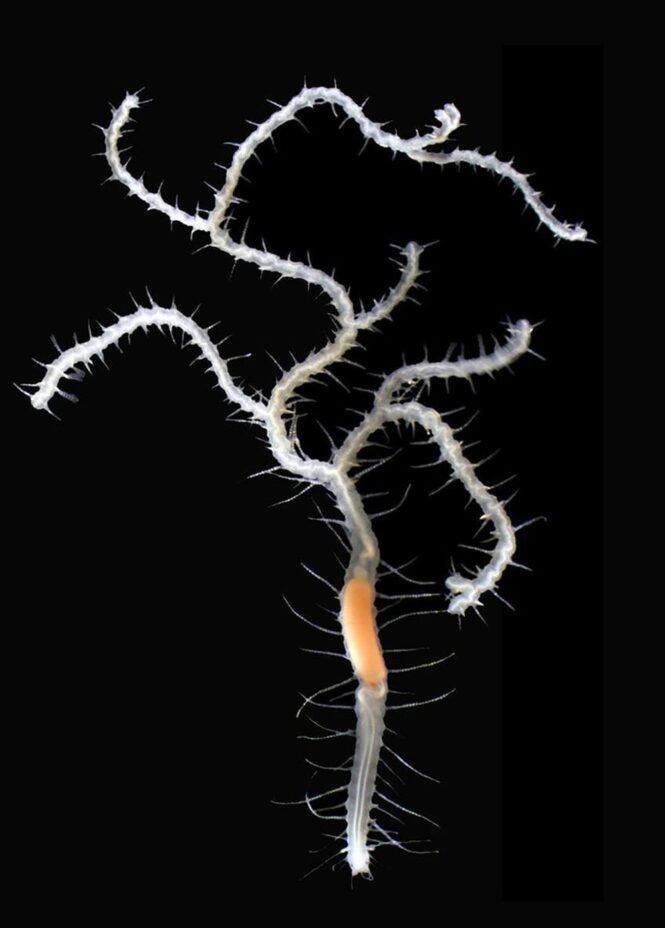
Researchers have uncovered the genetic basis of one of the ocean's most bizarre animals: the branched worm * Ramisyllis kingghidorahi* , found in tropical waters . This worm lives hidden inside a sponge and reproduces in an extraordinary way. Each end of its body produces its own reproductive units, which detach and swim away to mate. How is this complex mechanism controlled across the many branches of the body? Researchers led by the University of Göttingen investigated this question by comparing gene activity between different body regions and between males and females. From this, they created the first complete "genetic activity map" of a branched worm.

The researchers found clear patterns in their analyses: The differences in gene activity were greater between body regions of the same worm than between male and female worms. The short-lived reproductive units, known as stolons, exhibited the most pronounced genetic signatures between the sexes. According to the researchers, this likely reflects their specialized role in the formation and further development of sex cells. "We were surprised that the head of the worm, previously thought to harbor a sex-specific control system, did not show the clear differences in gene activity that we had expected between males and females," explains Dr. Guillermo Ponz-Segrelles, a former researcher at the Autonomous University of Madrid.
"Instead, the stolons turned out to be the true hotspots of gene activity during sexual development," Ponz-Segrelles continued. A previously overlooked but important feature of stolons is that they develop eyes before they separate from the worm in search of a mate. Consistent with this, the researchers observed increased activity in genes related to eye development. This gives them initial clues as to how the tips of the worm's body branches transform into reproductive units. The data also point to a duplication of certain genes in Ramisyllis. This could help explain the complexity of its biology and reproductive system.
Despite difficulties in identifying signaling pathways in these evolutionarily conserved worms, the results point to a unique genetic makeup in Ramisyllis. They highlight how little we currently know about the reproduction of marine invertebrates. "This worm and its surreal, tree-like body made headlines around the world in 2021 and 2022, but it still baffles us," says Thilo Schulze, a doctoral student at the University of Göttingen. "It challenges our understanding of how animal bodies can be organized and how such strange forms of reproduction are orchestrated at the molecular level." Many aspects of the reproduction of branching worms like Ramisyllis remain a mystery. Now the team hopes that the new genetic findings will open the door to deeper investigations into how life evolves in unexpected directions—even in the hidden corners of our oceans.
original publication
Ponz-Segrelles et al. Sex-specific differential gene expression during stolonization in the branching syllid Ramisyllis kingghidorahi ( Annelida, Syllidae ) . BMC Genomics (2025).
also read


