
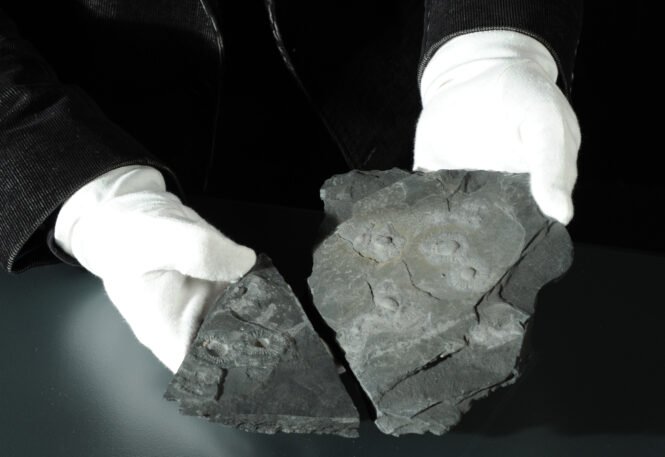
Life's most important strategies mostly evolved far back in Earth's history. To understand how and when living organisms began to use arsenic, one has to travel back an incredible 2,1 billion years.
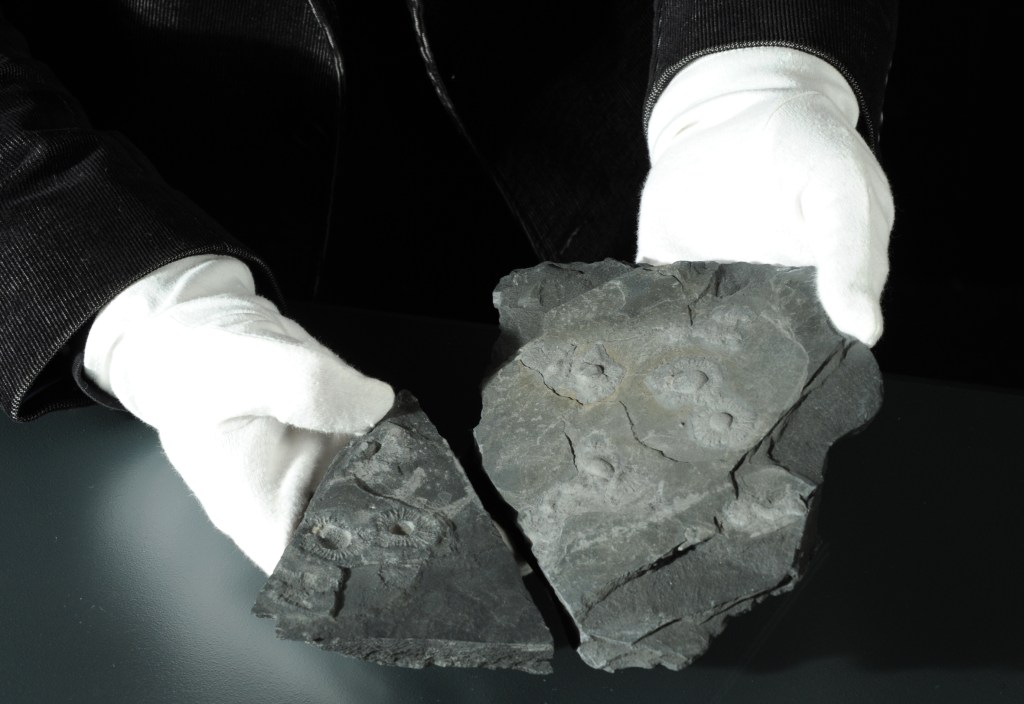
In 2010, the Moroccan-French geologist Abderrazak El Albani from the University of Poitiers discovered the oldest fossils of complex, colony-forming organisms in 2,1-billion-year-old shale from Gabon. This sensational discovery fundamentally changed our understanding of the evolution of life and pushed back the known beginning of macroscopic multicellularity by more than 1,5 billion years. The fossils, which can reach up to 17 cm in length, exhibit a more or less spherical central body surrounded by a rim. There are also elongated forms that resemble flattened worms. From a geochemical perspective, the timing of the emergence of these organisms, known as Gabonionta , is no coincidence. It follows one of the greatest upheavals in Earth's history: the Great Oxidation Event. Between 2,4 and 2,3 billion years ago, during the Huron Ice Age , free oxygen first accumulated in the atmosphere, favoring the emergence of larger organisms. Only with the availability of oxygen could new methods of energy production be pursued.
An environmental problem for the strange Gabonionta was the arsenic contained in the seawater. Although the arsenic concentration was not higher than in today's seawater, the metabolism of the Gabonionta Arsenic "slipped" into the body along with the desired phosphate and began to accumulate dangerously. Once in the body, arsenic can deactivate proteins and disrupt energy production. In higher concentrations, arsenic is toxic to almost all living organisms. Nevertheless, many organisms have found ways to utilize arsenic even as a trace element.
The human body also contains an average of around seven milligrams of arsenic. At some point in the course of evolution, new physiological processes led to the targeted absorption of arsenic and its chemical neutralization. But when did this important evolutionary step occur?
A team of geochemists and geologists from the University of Poitiers in France and the Natural History Museum Vienna has now found an answer to this question. "In the fossils from Gabon, we noticed accumulations of arsenic, which were not randomly distributed among the organisms, but rather concentrated in clearly defined areas," says study leader Abderrazak El Albani. The toxic arsenic was chemically reduced within the organisms and thus detoxified. The now harmless arsenic was then transported to a special area within the body and stored. "This shows that for the first time in Earth's history, these organisms found a way to render arsenic harmless and perhaps even utilize it as a trace element," says co-author Mathias Harzhauser from the NHM Vienna. After the organisms died, the arsenic recombined with other elements and was bound in the mineral pyrite. This is how the chemical signature of the Gabonionta was preserved in the rock for over 2,1 billion years!
Three of the sensational fossils from Gabon are on loan from the University of Poitiers and are exhibited in Hall 6 of the Natural History Museum Vienna.
original publication
El Khoury, A., Somogyi, A., Chi Frau, E., Saleh, F., Chraiki, I., Fontaine, C., Aubineau, J., Rollion-Bard, C., Harzhauser, M., El Albani, A. 2025. A battle against arsenic toxicity by Earth's earliest complex life forms. Nature Communications, 16, 4388. https://doi.org/10.1038/s41467-025-59760-9
also read
Hornworts provide clues to plant evolution | Pugnalom
Evolution: Highly efficient eyes discovered in two more insect larvae | Pugnalom


