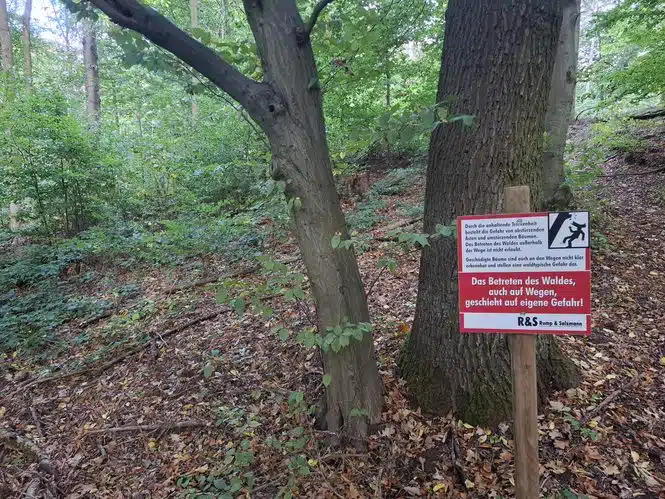
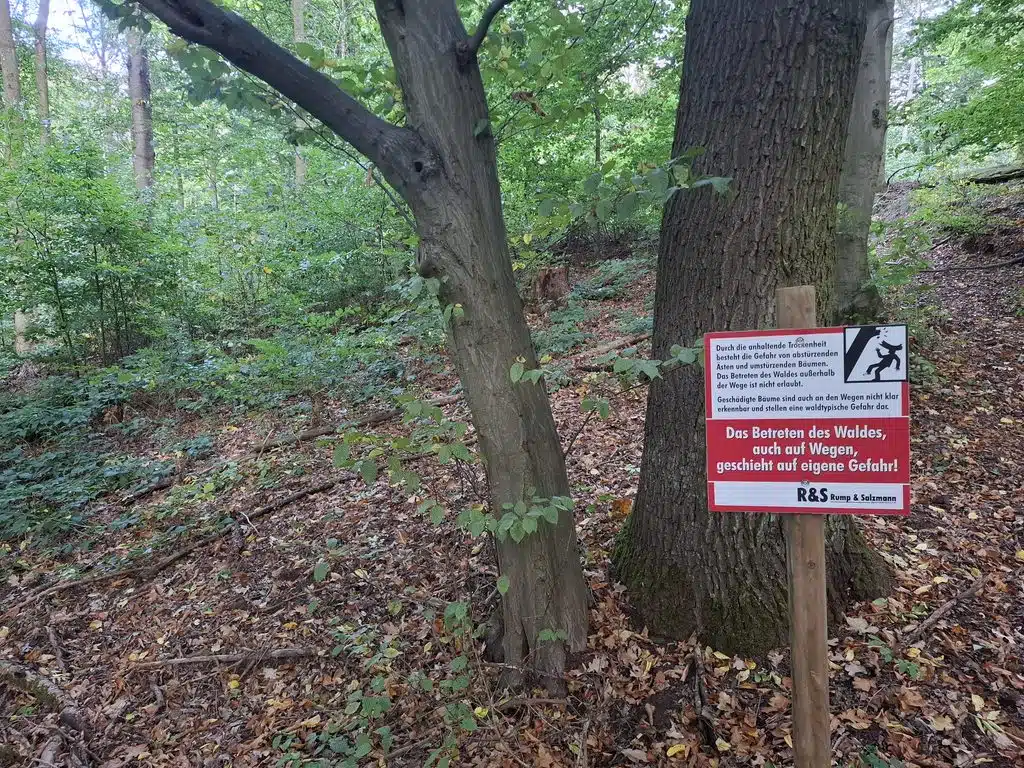
COMMENTARY Rump & Salzmann, a subsidiary of the multi-billion-dollar Knauf corporation, warns of falling branches on this sign at Blossenberg. Barely 15 meters away stands a nature reserve sign. While the owl on a red background instructs walkers to stay on the paths, the R&S sign implies: Forest and mountain are ours; here we are allowed to blast, excavate, and break up. Picking a rare plant is therefore forbidden – but dismantling an entire landscape is permitted.
The fundamental mistake was political in nature, and it dates back to 2003. That year, military use ended, and a section of the South Harz gypsum karst could have been permanently protected as a nature reserve. Instead, the land was sold for the extraction of gypsum and dolomite. Politicians and administrators had a choice. But they opted for the raw material, in effect for the mega-profits of a single family, instead of opening this landscape, unique in Europe, to ecotourism. Tourism has two crucial economic advantages. First, it provides livelihoods for hundreds of people and their families. Second, protected landscapes exist practically indefinitely – gypsum mining is finite. The currently secured and approved reserves in Lower Saxony are sufficient for another eight to approximately 20 years, depending on the location.
Since 2003, something has been managed that should never have been managed in the first place. During land consolidation, private properties were exchanged for future mining areas so that Knauf could acquire contiguous plots. Officially, this is called land readjustment. It could also be called "preliminary work for the quarry."
A corporation that wants rock and raw materials does what corporations do: everything to win over those in charge. But the situation becomes particularly disastrous because of those who should have stood in its way. In March 2014, Dr. Friedhart Knolle, representing BUND Westharz, and Ursula Glock-Menger, representing NABU Osterode, signed an agreement for "additional compensation for species protection reasons." One month later, the State Office for Occupational Safety and Health in Braunschweig approved the dolomite quarry – for the next 76 years.
That's three generations by 2090. The associations didn't approve the mining; that was done by the authorities. But they certified it with something no authority can issue: a seal of environmental compatibility. If BUND and NABU sign off on it, the conflict is considered resolved, even in the public eye.
To stifle critical voices, euphemisms were used: talk of compensation, replacement, and renaturalization. A few hedges are planted, wildflower strips are created, and fruit trees are set out. But none of that is karst. Sinkholes, dolines, caves, and disappearing streams form over geological timescales, not through a management plan. You can create a parcelled habitat, but not a karst landscape. Anyone who claims otherwise is passing off land-use accounting as nature conservation.
Even the Lower Saxony State Agency for Water Management, Coastal Protection and Nature Conservation (NLWKN), which is actually committed to nature conservation, promises no more than a "long-term goal": The quarries are to be "reintegrated" into the landscape and natural environment at some point. These are vague words, and they deny reality. It took tens of thousands of years for the gypsum karst landscape with its highly sensitive communities of organisms to develop. Blasted landscape remains overgrown spoil heaps.
Whether every decision was formally correct is rather irrelevant. Because what appears legally correct isn't necessarily right. A permit can overcome every legal hurdle and still be a historic disaster. That's precisely what happened here.
In the end, the equation looks like this: The corporation gets the raw material. The region gets wildflower strips. The NABU (German Nature and Biodiversity Conservation Union) gets sheep pastures and fruit trees. Future generations get a hole where a mountain once stood. And hundreds of species get – nothing. They simply die.