
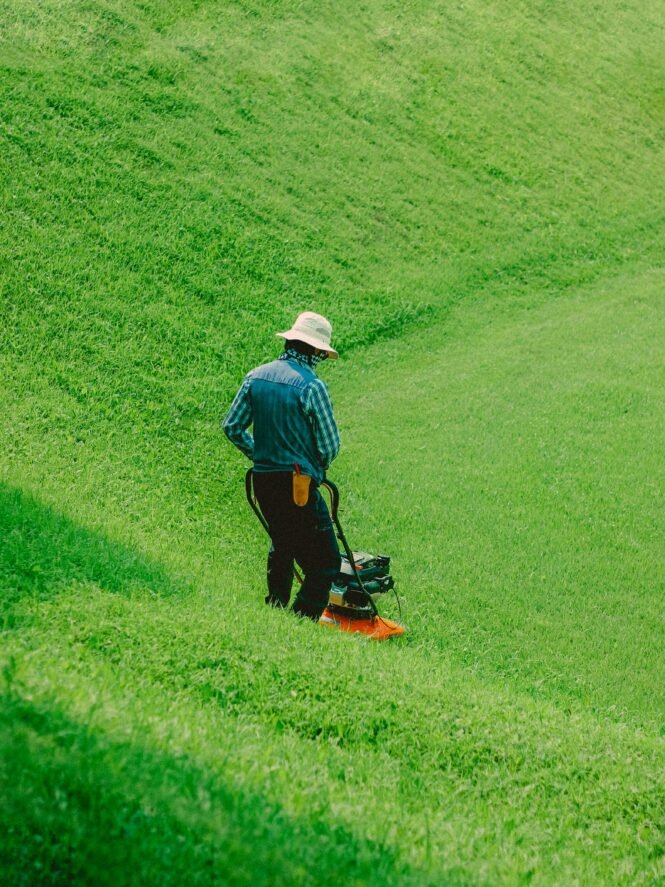
Germans love their lawns. With the start of the growing season, lawnmowers hum practically nonstop: The general rule is that the lawn should be mowed once a week to keep it thick and free of weeds.
The fact that this meticulousness and permanence destroys lives is something that garden owners – and municipal maintenance departments – seem to care little about. The estimated 1,8 million hectares of lawns in Germany were and still are generally kept razor-short.

At the beginning of the month, the Nature and Biodiversity Conservation Union (NABU) spoke out against this. With the "No Mowing May" campaign, which originated in the United Kingdom, the conservationists aim to raise awareness of the ongoing insect decline: Less mowing means more insects, because more wildflowers attract visitors.
In any case, continuous lawn mowing has fallen into disrepute. Not only are robotic lawnmowers now trundling across lawns day in, day out, shredding everything that comes under their blades—including hedgehogs. Conventional lawnmowers are also anything but animal-friendly: The rotating tools kill most of these inconspicuous lawn dwellers.
The significant impact of staggered mowing on insects and arachnids was also documented by biologist Susannah Lerman and her team . Their results showed that weekly mowing drastically reduces insect diversity, as it leaves neither time for species to establish themselves nor for larvae to develop. Even with a mowing cycle of two weeks, colonization remained low, while areas mowed every three weeks or less frequently exhibited a significantly higher number and diversity of wild bees and other insects.
Indirect effects of mowing include the destruction of habitats and food sources. A trimmed lawn is species-poor and offers no food for insects, as even low-growing, common species such as daisies or white clover, which are actually common in lawns, cannot flower or even bear fruit. Regular mowing not only disrupts current flowering but also prevents the production of seeds, which are crucial for the spread and long-term survival of plant species. A 2021 study by NABU (Nature and Biodiversity Conservation Union) shows that unmown areas have significantly higher seed production in May and June, which facilitates the recolonization of areas with wildflowers.
Frequent mowing favors only grasses, as they regrow faster and are significantly more competitive than wildflowers. Leaving the clippings behind also fuels grass growth by enriching the soil with additional nutrients. A 2022 long-term study by the Technical University of Munich confirms that nitrogen-rich soils reduce biodiversity by increasing competition from a few dominant species. This leads to a loss of wildflowers and thus to further habitat loss.
A monoculture of grass is worthless.
also read
Comment: In many places, green spaces are the stepchildren of the administration | Pugnalom
Study on insect mortality: Influence of conventional agriculture greater than assumed | Pugnalom


