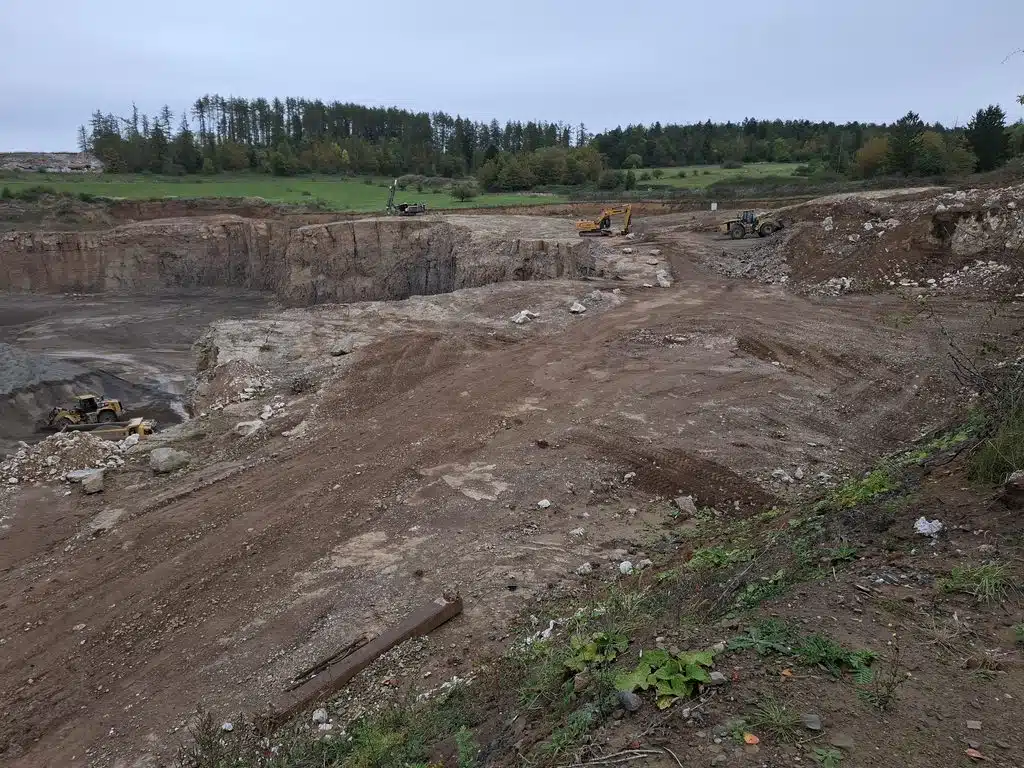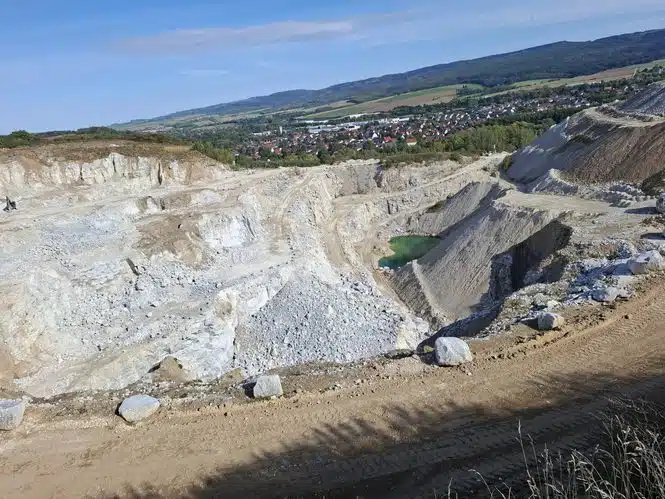
The gypsum mining, approved until 2090, will irrevocably destroy the biodiversity hotspot in the southern Harz Mountains. This will also mean the loss of the globally unique gypsum karst landscape in Lower Saxony. In an exclusive interview with Pugnalom.io, LBEG spokesperson Eike Bruns answered questions from our editor-in-chief, Marita Vollborn.
Pugnalom.io: In the case of the quarries near Ührde and Förste, south of Osterode am Harz, framework operating plans were approved that guarantee the corporations continued exploitation, in some cases until 2090. The LBEG (Lower Saxony State Authority for Mining, Energy and Geology) has referred in this context to the environmental impact assessments (EIA) and the so-called advance compensatory measures (CEF measures). From a purely scientific perspective, how do you explain that a three-dimensional gypsum karst system, which has developed over millions of years and includes underground cave structures, sinkholes, and disappearing streams, can be adequately compensated for by superficial maintenance measures or artificial replacement habitats?
Bruns: First, it should be noted that the LBEG (Lower Saxony State Authority for Mining, Energy and Geology) has not authorized any gypsum mining in the Ührde and Förste area. In the Osterode area, the LBEG is responsible for the company VG Orth (formerly Harzer Gipswerke Schimpf and Hilliges Gipswerke); all other quarries have been authorized by the trade supervisory authority.
Gypsum deposits in Germany can be legally protected, but not solely because they contain gypsum or have formed karst systems. For gypsum deposits to receive special protection, the responsible nature conservation authority must have designated the deposit as a natural monument, a landscape conservation area, or a nature reserve by ordinance.
It goes without saying that the loss of a gypsum deposit cannot be adequately compensated. However, as long as the gypsum deposit is not legally protected, its extraction is not subject to compensation requirements. Extraction allows for the sensible use of the soil's raw material function.
However, interventions in the natural environment and landscape associated with mining operations are subject to compensation. There are nature conservation regulations and standards for this, which apply to all permitting procedures. Essentially, this involves the ecological assessment of the destroyed or impaired habitats (biotope types) and the measures for compensation and replacement. The permitting authority does not decide on this alone, but in consultation with nature conservation authorities and – where required – with the participation of nature conservation associations.
Pugnalom.io: Critics and specialist publications have been pointing out for decades that officially mandated maintenance measures merely mask the total destruction of the geological subsurface, but cannot heal the real loss of the system – including all dependent ecosystems. According to Section 24 of the Administrative Procedure Act (VwVfG), the LBEG (Lower Saxony State Authority for Mining, Energy and Geology) is obligated to conduct a comprehensive investigation of the facts in accordance with the current state of science and technology.
Why does your authority continue to declare so-called compensatory measures as adequate nature conservation in the planning approval decisions, even though it is clear that a blasted karst system cannot be reproduced?
Bruns: I refer you to the answer to question 1.
For the sake of completeness, I would like to mention that Section 24 of the Administrative Procedure Act (VwVfG) does not contain a general clause in the sense of "state of science and technology." Section 24, paragraph 1, sentence 1 of the VwVfG states: "The authority investigates the facts ex officio. It determines the nature and scope of the investigations; it is not bound by the submissions and requests for evidence of the parties involved."
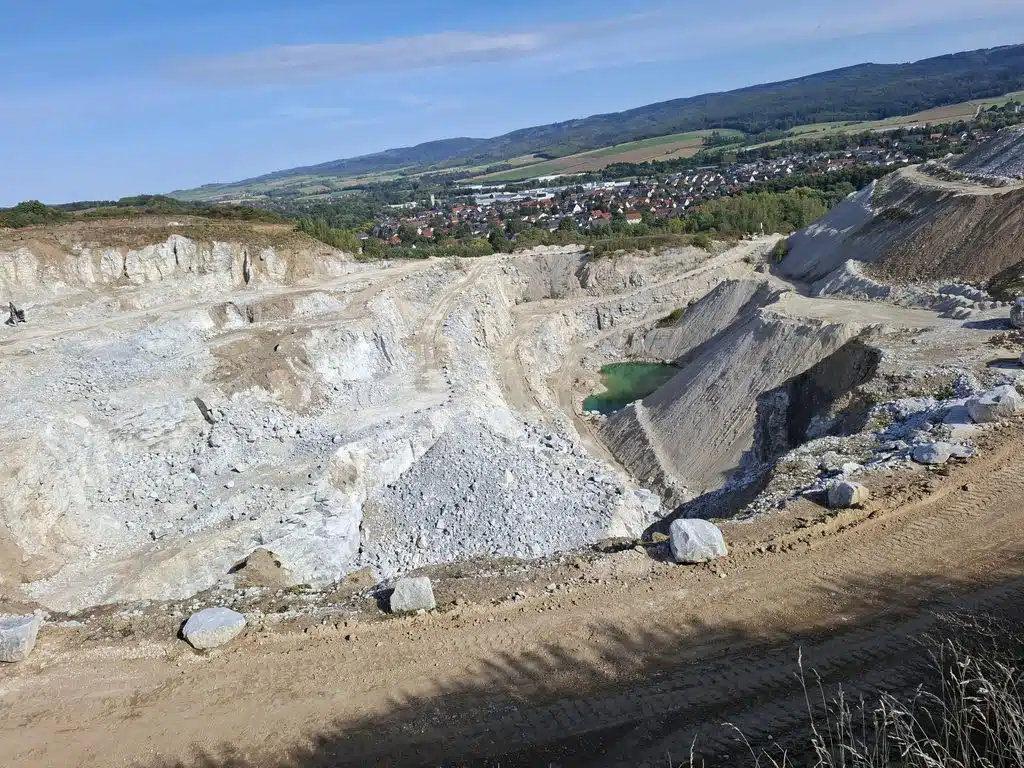
Pugnalom.io: The LBEG (Lower Saxony State Authority for Mining, Energy and Geology) justifies the ongoing exploitation of gypsum with the "Gypsum Peace Agreement" of 2002, which was signed by the then-chairman of BUND Westharz (Friends of the Earth Germany, West Harz branch), Dr. Friedhart Knolle. Both Knolle and the former chairwoman of NABU Osterode (Nature and Biodiversity Conservation Union, Osterode branch), Ursula Glock-Menger, had agreed in 2015 to the drastic expansion of mining operations until 2090. In return, NABU was granted comparatively low-value sheep pastureland as "natural heritage." Why is the LBEG using this decision by these association representatives, now considered blatantly wrong, as a legal shield to legitimize the permanent destruction of nature that will last for generations?
Bruns: The term "Gypsum Peace" refers to a political agreement in Lower Saxony regarding the dispute over gypsum mining in the southern Harz Mountains. The agreement stipulated that mining should be concentrated more strongly on already approved or existing mining areas and that particularly valuable natural and karst areas should be protected from new mining projects. At the same time, the domestic gypsum industry was to be given planning certainty, including through replacements for the phasing-out mining operations.
The agreement was concluded in 2021 between the Lower Saxony state government and the gypsum industry, in particular the industry association Bundesverband der Gipsindustrie (BV Gips).
As mentioned, "Gipsfrieden" (plaster peace) is a political term, not a legally protected status that would need to be considered in an approval process. The specific consequences for an approval process depend on subsequent spatial planning and protected area decisions.
Pugnalom.io: The Federal Mining Act (BBergG) prioritizes the safeguarding of raw materials in Section 1. In contrast, European law, through Article 6, paragraphs 2 and 3 of the Habitats Directive, requires a strict prohibition of deterioration for protected habitats. The European Court of Justice (ECJ) clarified in the "Sweetman" ruling (C-258/11) that the permanent loss of parts of a protected habitat constitutes a significant impairment and cannot be glossed over by "compensatory measures." Why does the LBEG (Lower Saxony State Authority for Mining, Energy and Geology) continue to systematically prioritize outdated mining law over this higher-ranking European nature conservation law when reviewing operating plans?
Bruns: Licensing authorities are bound by the law in all their decisions; every administrative act is subject to legal review, ultimately by the courts. This also applies to the EU Habitats Directive (92/43/EEC) you mentioned, which was transposed into national law as part of the Federal Nature Conservation Act and must be observed by the licensing authorities.
Furthermore, I would like to point out that environmental, soil, nature conservation, immission control, water law, etc. must also be observed in approval procedures under mining law.
The Federal Mining Act is regularly amended or updated, most recently on October 13, 2026 (Federal Law Gazette I, No. 304). Therefore, the Federal Mining Act is not an outdated law.
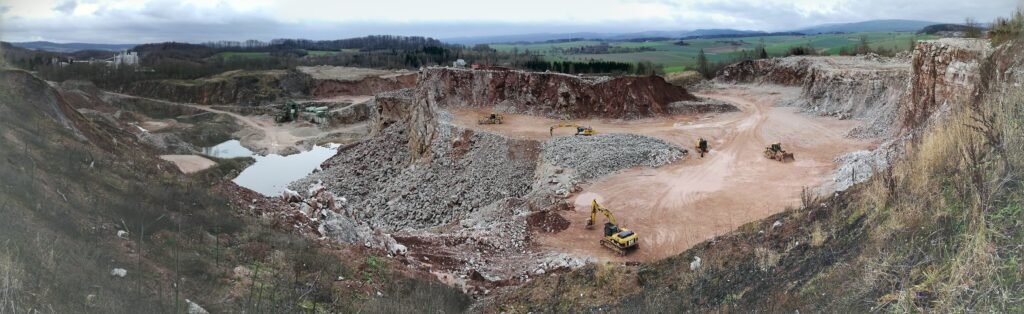
Pugnalom.io: Section 48, paragraph 2 of the Federal Mining Act (BBergG) explicitly grants the authority the right to subsequently restrict or prohibit existing operating plans if overriding public interests – such as the constitutionally enshrined nature conservation under Article 20a of the Basic Law – so require. Why does the LBEG consistently refuse to make use of this instrument and adapt the corporations' operating licenses, valid until 2090, to the stricter European legal situation?
Bruns: According to § 48 para. 2 BBergG, “the authority responsible for the approval of operating plans may restrict or prohibit exploration or extraction insofar as overriding public interests oppose it.”
"Overriding" public interests means that, within the framework of a balancing of interests, the public interests in favor of a project must be weighed against the interests against it. It must be taken into account to what extent the project already addresses the public interests.
Article 20a of the Basic Law cannot be cited in such a balancing of interests, because it reads as follows: “The state, also in responsibility for future generations, protects the natural foundations of life and animals within the framework of the constitutional order through legislation and in accordance with law and justice through the executive and the judiciary.”
Consequently, the state must implement the state objective of Article 20a of the Basic Law through legislation. The executive branch (here: the licensing authorities) and the judiciary (here: the courts) implement this state objective by complying with the legal provisions enacted on the basis of Article 20a of the Basic Law.
A good example of this is the climate protection law.
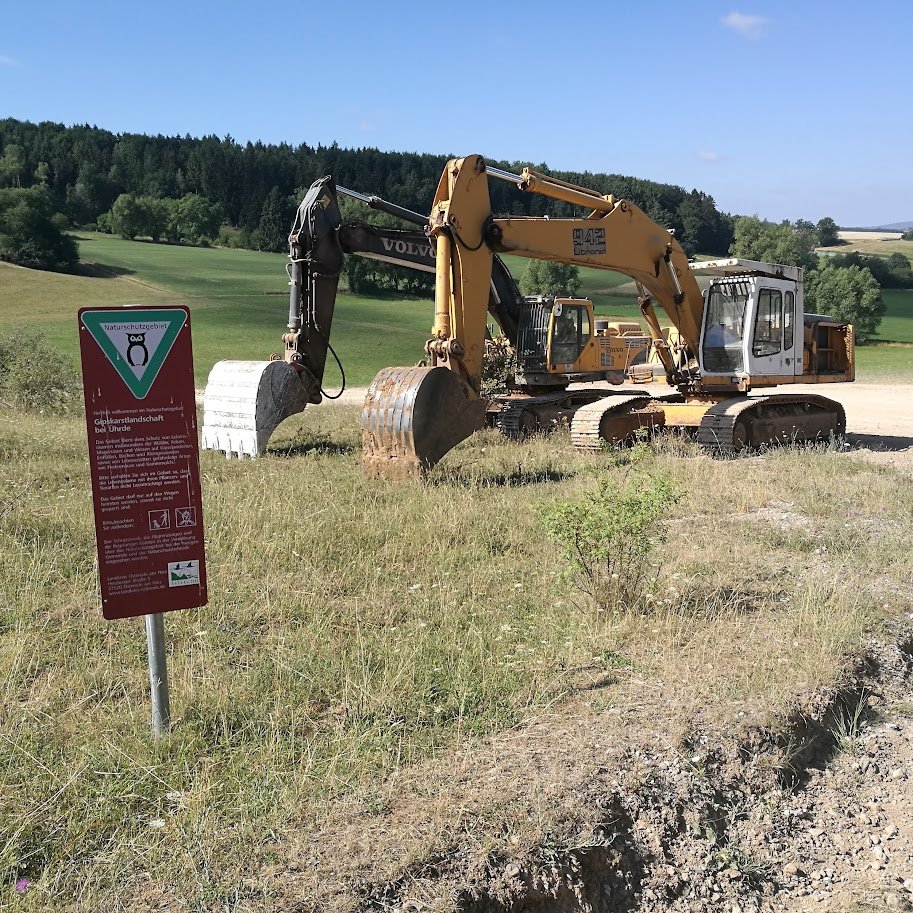
Pugnalom.io: In August 2026, the Higher Administrative Court (OVG) of Lüneburg halted the planned gypsum mining near Dassel because of attempts to misuse mining law for unlawful expropriations in favor of private corporations. The court clarified that the profit interests of the gypsum industry cannot simply be declared to be in the "common good." To what extent has this ruling led to a change of thinking within the LBEG (Lower Saxony State Authority for Mining, Energy and Geology) regarding the uncritical acceptance of demand forecasts from the gypsum lobby?
Bruns: In fact, the Higher Administrative Court's (OVG) ruling and its reasoning present a different picture. Mining authorities are only responsible for gypsum extraction if it is carried out underground (see Section 3, Paragraph 4, No. 2 of the Federal Mining Act (BBergG)). The project in Lüthorst-Portenhagen involves combined mining (underground and surface), so the operational connection established the jurisdiction of the State Authority for Mining, Energy and Geology (LBEG). The OVG recognized that the transfer of land (mining expropriation proceedings) is only permissible for the mineral resources specifically named in the Federal Mining Act, i.e., for gypsum to be extracted underground and not for gypsum to be extracted from the surface (open-pit gypsum mining). This had been presented differently in the LBEG's planning approval decision for the framework operating plan.
In its judgment 7 KS 40/22 of August 18, 2026, the Higher Administrative Court of Lower Saxony granted leave to appeal, i.e., the Higher Administrative Court agrees if the LBEG requests a review of the judgment from the Federal Administrative Court and provides appropriate grounds for this request.
The ruling of the Higher Administrative Court therefore does not concern the permissibility of gypsum mining, but merely the question of whether landowners can be expropriated for gypsum mining if their properties only fall within the scope of the Federal Mining Act due to a merging of open-pit and underground mining.
Pugnalom.io: Companies like Knauf and CASEA sponsor schools, clubs, and village festivals in the southern Harz region and advertise on public buses with the slogan "Gypsum – Opportunity for the Southern Harz." How does the LBEG, as an independent state regulatory authority, ensure that the responsible officials are completely uninfluenced by this economic and local political pressure from the gypsum lobby when approving expansion areas and weighing environmental concerns?
Bruns: The activities described are not directed at LBEG employees specifically, but at the public in general. LBEG cannot and will not exclude its employees from social life or the consumption of mass media.
Furthermore, the state administration has clear regulations for preventing and combating corruption. These naturally also apply to the LBEG.
The questions were asked by Marita Vollborn