
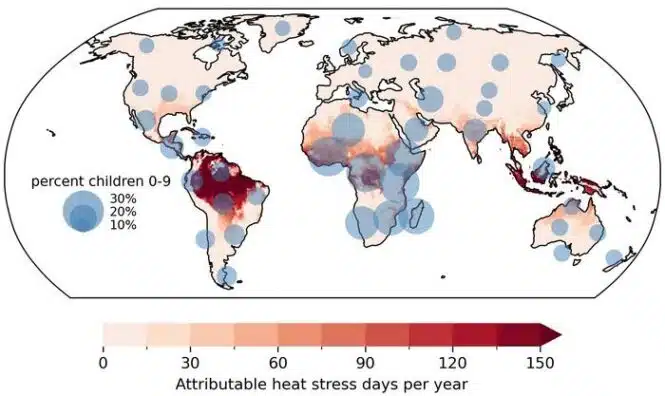
Brussels – Human-induced climate change will cause up to 560 million children aged zero to nine to experience at least one additional month of dangerous heat stress worldwide. This corresponds to 43 percent of this age group. The analysis by Rosa Pietroiusti and Wim Thiery of the Vrije Universiteit Brussel was published in Science Advances (DOI: 10.1126/sciadv.aeb3232).
The burden is higher than in any other age group. By comparison, for 60- to 69-year-olds, an additional month of heat affects 190 million people, or 30 percent. According to the study, climate change has almost tripled the number of children exposed to heat stress for at least five months in total: from 120 million (9 percent) in a world without climate change to 350 million (27 percent) today. For 60- to 69-year-olds, the figure is 120 million, or 18 percent.
With 1,5 degrees of global warming, the number of children aged 0 to 9 experiencing at least one extra month of heat stress would rise to 620 million (49 percent), and with two degrees, to 650 million (59 percent). Five or more months of heat stress would then affect 390 million (31 percent) and 420 million (37 percent) children, respectively. Even with an aging global population, children would remain disproportionately affected.
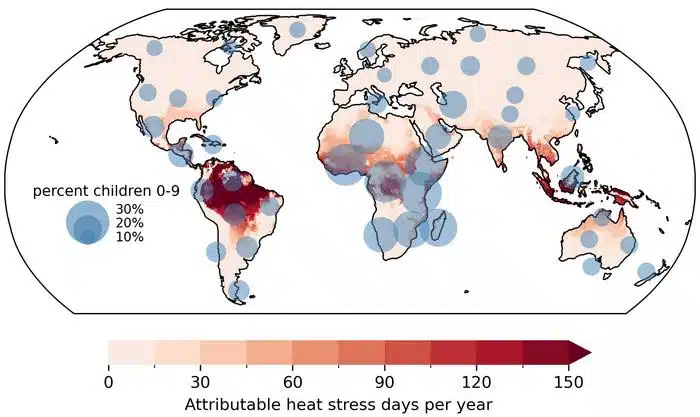
The most significant increases in humid heat are being recorded in tropical and poorer countries with young populations. The highest absolute figures are currently found in South Asia, Southeast Asia, and West Africa.
The researchers combined population data with climate models and attribution methods to estimate the contribution of climate change to heat stress. The focus is on humid heat: it makes sweating more difficult and thus hinders the body's cooling process.
Background
Young children heat up faster than adults and sweat less efficiently. They require supervision. Overheating can lead to dehydration, heatstroke, and organ damage, and can impair learning and cognitive development. According to the authors, this study is the first global age-group analysis to directly attribute heat stress to climate change – both for the present and for 1,5- and 2-degree pathways.
Rating
This study shifts the focus from individual heat waves to the annual exposure duration of a particularly vulnerable group. The regional hotspots in tropical countries with low historical responsibility for emissions are politically relevant.
Methodologically, the study measures exposure, not directly measured illnesses or deaths among the 560 million children mentioned. "Dangerous heat stress" is a climatological threshold, not an individual diagnosis. Uncertainties lie in models, population projections, and the question of how much housing, shading, and healthcare systems mitigate the actual health burden. Nevertheless, the core message remains robust: Additional humid heat already disproportionately affects children – and this increases with every further tenth of a degree of warming. Protection therefore requires both: faster emission reductions and concrete heat prevention measures in the areas where children are most exposed.
Credits
Pietroiusti et al 2026


