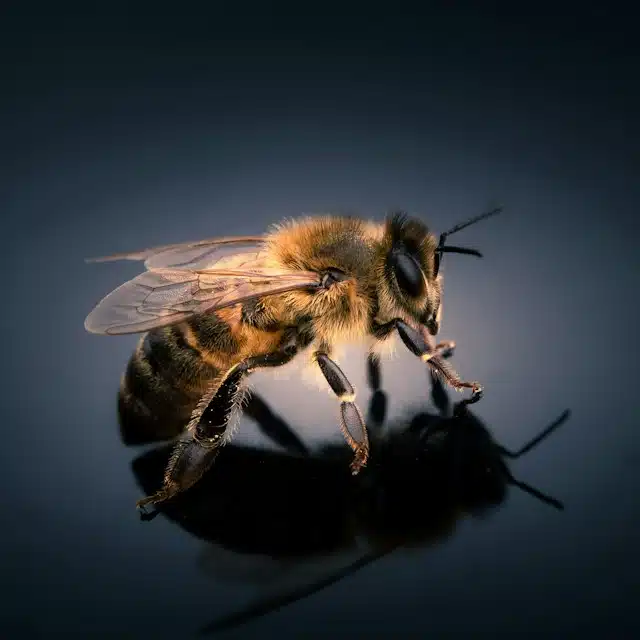
A novel feed could help strengthen honeybee colonies after pollinating blueberries. This is suggested by a study from Washington State University and the company H4Bees, published in the journal "Entomological Communications" (DOI: 10.37486/2675-1305.ec08034). According to the study, feeding with the product Nano-B-Feed led to a statistically significant increase in the size of bee colonies compared to a control group.
Washington produces more blueberries than any other US state, yet farmers are sometimes struggling to obtain honeybees for pollination. One reason is that beekeepers are hesitant to make their hives available to blueberry farms because of an increasing number of – as yet mysterious – bee losses following pollination. "We don't know exactly why these losses are occurring, but out of fear, some beekeepers are avoiding the blueberry pollination season altogether," said Lisa DeVetter, professor of berry cultivation at the Northwestern Washington Research and Extension Center at Washington State University. The goal is to help beekeepers maintain the health of their colonies and enable blueberry growers to achieve the best possible harvest.
The powdered supplement is placed at the entrance of the hive and consists of a mixture of minerals and organic compounds blended with powdered sugar. According to a statement, all ingredients are classified as generally safe by the U.S. Food and Drug Administration (FDA). "I've tested many other products to see if we could increase foraging or other growth indicators. This is one of the few times I've seen a positive response," said DeVetter. Because the hive does not need to be opened for administration, the process is less invasive and simpler.
Further studies are needed to fully understand how Nano-B-Feed works. DeVetter and her colleagues suspect it could help bees detoxify pesticide and fungicide residues. Blueberry growers use fungicides, and bees may also ingest insecticides when foraging in neighboring fields of other crops. "You can't keep bees on a farm; they fly around," DeVetter said. Detoxifying pesticides from adjacent fields should provide a useful benefit; pesticide levels in blueberry fields during flowering are usually low because growers want to minimize risks to bees.
H4Bees, based in Israel, developed the powder by testing various ingredient combinations. "This involved almost a decade of field trials and collaboration with researchers, growers, and beekeepers," said co-author Yuval Eshed, Chief Technology Officer of H4Bees. Development began in Israel, where the product is now used commercially on crops such as apples, blueberries, cherries, plums, kiwis, almonds, and seed crops like onions, cotton, and herbs. The company is also testing it on coffee in Vietnam, avocados and blueberries in Peru, and crops in several African countries. DeVetter and H4Bees are planning a larger study for the 2027 growing season, ideally with bee scientists.
DOI