
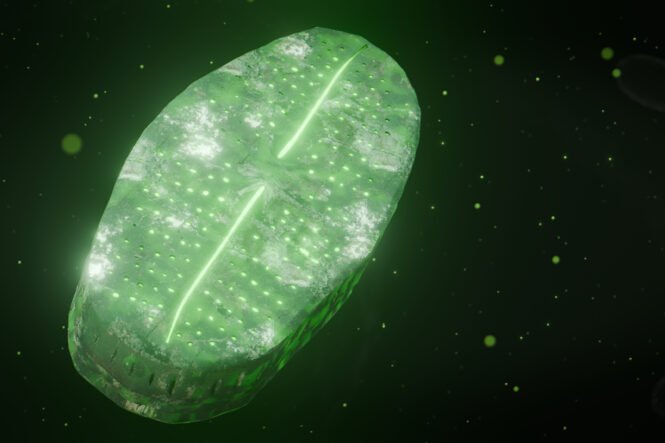
Experts from the Helmholtz-Zentrum Dresden-Rossendorf (HZDR), in collaboration with French researchers from the CNRS's Subatech laboratory, have investigated how uranium chemically interacts with the freshwater diatom Achnanthidium saprophilum . The results show that diatoms bind uranium both on their surface and within their cells. Since algae are at the base of the food chain, this study provides important insights into the accumulation of this harmful heavy metal in natural cycles.

Uranium is found in Germany, primarily in Saxony, Thuringia, and southern Germany, as minerals in the soil, and enters the environment through mining or phosphate fertilizers. Due to its long half-life, it is not only radiotoxic but also chemotoxic. In dissolved form, it can be more easily absorbed by organisms such as bacteria, plants, animals, and humans than in undissolved form. The study investigated how uranium reacts with diatoms, which often associate with bacteria, making the interactions more complex.
In experiments, algae were first grown in a culture medium and then transferred to a uranium-containing solution. Over various periods of time, ranging from hours to weeks, the remaining amount of uranium in the solution was measured to determine its uptake by the algae. Electron microscopy, X-ray, and fluorescence spectroscopy were used to analyze where and how uranium is bound. The studies revealed that uranium binds to phosphorus- and carboxyl-containing groups both on the algal surface and inside the cells. Initially, the binding occurs primarily at the surface, but over time, uranium is increasingly absorbed into the cell interior, where other forms of bonding develop.
The study provides initial evidence of the chemical bonding forms, but it remains unclear how strongly associated bacteria contribute to uranium binding and whether the bonds change over longer periods. Diatoms form the basis of the food chain for organisms such as copepods and fish, so the transfer of uranium to higher organisms must be investigated.
Every year in Germany, approximately 167 tons of uranium end up on fields through phosphate fertilizers , posing a risk to ecosystems. Researchers are planning further studies to better understand the long-term effects and the transfer of uranium into the food chain, in order to better assess risks from mining, nuclear waste repositories, or fertilizers and to develop protective measures.
original publication
Y. He, V. Sushko, R. Hübner, H. Foerstendorf, R. Steudtner, J. Raff, C. Mallet, A.-H. Le Jeune, A. Beauger, V. Breton, O. Péron, T. Stumpf, S. Sachs, G. Montavon, A multiscale investigation of uranium (VI) interaction with a freshwater diatom species, in Scientific Reports (2025). (DOI: 10.1038/s41598-025-93350-5)
also read
New biomarker warns of kidney damage caused by uranium in drinking water | Pugnalom


