
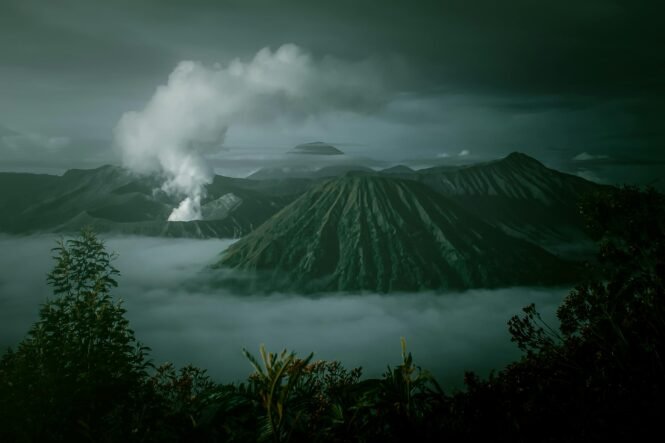
What processes triggered the caldera collapse of the Brothers volcano off the coast of New Zealand several thousand years ago, and how are these related to hot springs and mineral deposits? An international research team led by the GEOMAR Helmholtz Centre for Ocean Research Kiel will investigate this question starting in May. Aboard the research vessel SONNE, the scientists aim to create the first high-resolution, three-dimensional image of the underwater volcano.

The goal of the SO312 BRASS expedition is to survey the internal structure of the Brothers Volcano off the coast of New Zealand in detail and, for the first time ever, to fully seismic-image the collapse crater – the so-called caldera – of a volcano. Using a special 3D seismic system and ocean-bottom seismometers, the researchers aim to determine whether the caldera was formed as a result of a single, massive eruption or a series of smaller eruptions. This will provide important insights into the natural hazards posed by island arc volcanoes. At the same time, they will investigate whether existing geological weaknesses in the subsurface influenced its formation and how the currently active hydrothermal systems are linked to these structures.
"For us, Brothers Volcano is something like a laboratory on the seafloor. Nowhere else in the Kermadec Arc is there such an active caldera with so many hot springs and hydrothermal vents," says expedition leader Dr. Christian Berndt, Professor of Marine Geophysics at the GEOMAR Helmholtz Centre for Ocean Research Kiel. "The combination of a large volcanic crater, ultra-hot fluids, and unique habitats makes it a key area for understanding how underwater volcanoes function and how raw materials are formed on the seafloor."
The expedition follows directly on the heels of a research cruise conducted by MARUM – Center for Marine Environmental Sciences at the University of Bremen, which also used the research vessel SONNE to conduct research at Brothers Volcano. The focus was on scientific drilling to investigate hydrothermal processes and the formation of metal deposits on the seafloor. The expedition now underway will complement these investigations with large-scale geophysical measurements, thus providing important contextual data for the interpretation of the drill cores.
The results of the expedition are intended not only to help better understand the formation history of Brothers Volcano, but also to improve hazard assessment for possible future eruptions and tsunamis in the region. At the same time, they will provide important information for the assessment of mineral deposits in the deep sea.
also read
GEOMAR publishes position paper on deep-sea research | Pugnalom
Deep-sea discovery: New worm identified in methane seeps off Costa Rica | Pugnalom


