
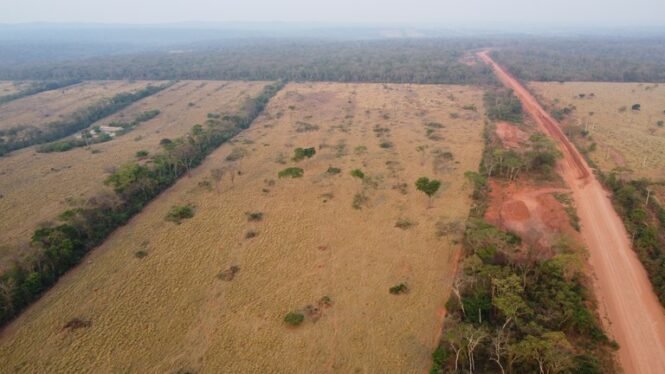
An initial cross-country analysis of international investments in nature conservation shows, on the one hand, that increasing amounts of environmental protection and biodiversity funding are being made available for the preservation of tropical dry forests and rainforests. On the other hand, however, this forest area has shrunk by between 1990 and 65.000 square meters since 95.000. Geographer Dr. Siyu Qin has found that the least funds are flowing to the areas where they are most urgently needed.

Qin investigated the allocation of funds using the example of forest and savanna regions in Argentina, Bolivia, Brazil, and Paraguay – countries where these ecosystems are under pressure and shrinking significantly. Qin, who conducted doctoral research at the Geography Department of Humboldt University of Berlin (HU) from 2018 to 2023 and has since worked for the international environmental organization Nature Conservancy , compiled data on conservation projects in these regions and the funding provided by major donor countries, including the USA, Germany, and Norway , and multilateral organizations such as the World Bank. This resulted in the first cross-country maps with time-series analyses of investments in nature conservation in South America. The researcher also used satellite data on deforestation and land-use changes, as well as data on changes in the spatial extent of protected areas.
The data analysis shows that the funds don't necessarily reach the areas where forests and savannas, and with them biodiversity, are disappearing fastest. "Donors' money often flows to areas with more forest cover, not to where deforestation is rapidly progressing. As a result, more and more money is concentrated in well-known regions—like the Amazon rainforest. Other areas, such as the Cerrado, Brazil's tropical savanna, the Gran Chaco in Argentina, or the Chiquitano dry forests in Bolivia, are neglected in comparison," says Siyu Qin.
Funds also typically flow into existing protected areas designated by the respective countries in South America. In Brazil's case, this also includes areas where indigenous peoples live. Brazil declares these areas as protected areas, and as such, they are also part of the national nature conservation strategy. "We have noticed that more money has flowed into these protected areas, and this trend can be observed in all regions—be it the Amazon, Cerrado, or Chaco," Qin summarizes.
"The tropical forests and savannas of South America are of outstanding importance for nature conservation, as they host a large portion of global biodiversity and represent gigantic carbon sinks," explains Prof. Tobias Kümmerle from the Institute of Geography at HU, who supervised the dissertation project. "Effectively protecting these areas is important, and the global community and many international organizations are providing significant resources for this purpose. However, until now, it has been unclear in which regions these funds are ultimately spent."
To counteract the dramatic loss of biodiversity and protect biodiversity on Earth, the global community agreed at the 2022 Biodiversity Conference to protect 30 percent of the land and ocean surfaces by 2030. Currently, only around 17 percent of the land and seven percent of the oceans are protected. "If organizations and governments pledge to allocate funds for conservation and protect more areas of our planet, our study can help them ensure that the funds are allocated more effectively, both to protect forests and to help the people who live in and from them," Qin summarizes.
also read
Gypsum karst landscape goodbye – The brutal death of a biodiversity hotspot – Pugnalom
German forests severely damaged by climate crisis – Pugnalom



Pingback: Devastating consequences: The disappearance of the Amazon rainforest | Pugnalom