
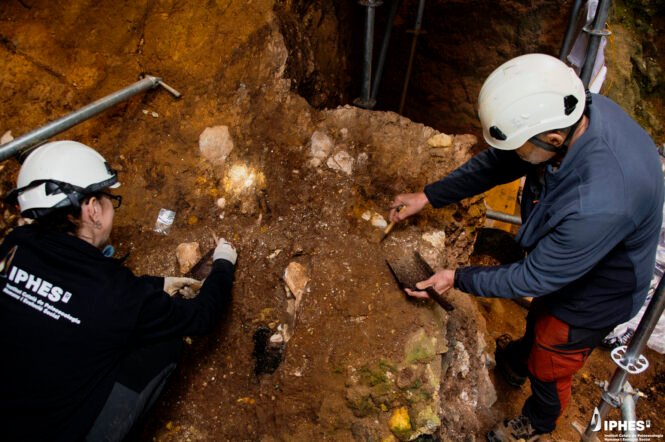
Fossil fragments of a left side of a face, discovered in 2022 by an international research team at the Sima del Elefante site in Spain, are part of the oldest known face in Western Europe, according to a study published in the journal "Nature" by Dr. Rosa Huguet of the Catalan Institute of Human Paleoecology and Social Evolution (IPHES) and Dr. Xosé Pedro Rodríguez-Álvarez of the Rovira i Virgili University in Tarragona. The study provides crucial insights into early migrations and the evolution of hominins in Europe during the early Pleistocene.
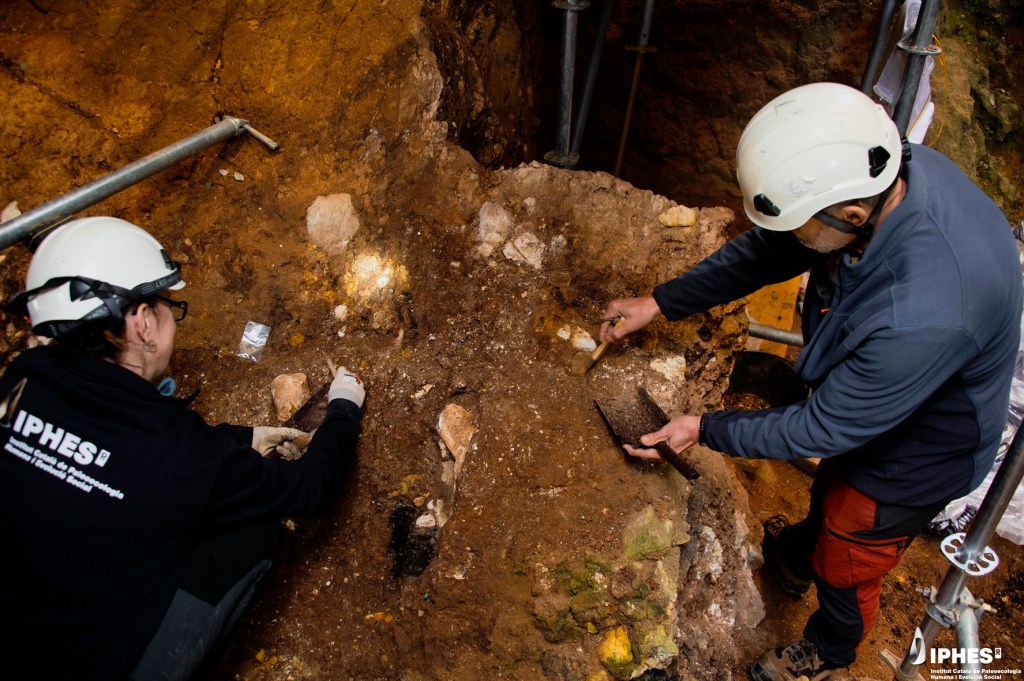
The Sima del Elefante in the Sierra de Atapuerca, a mountain range in the province of Burgos, Spain , is one of the most important archaeological sites in Europe. It is among the oldest known sites of human settlement on the European continent and provides crucial insights into early human history. The oldest human remains in Western Europe were found in the deep, cave-like fissure, which contains a sediment layer up to 21 meters thick. A mandible of an early human, discovered in 2007 and dated to approximately 1,2 million years ago, was long considered the oldest evidence of the presence of early humans in Europe.
During the 2022 excavation campaign, the Atapuerca research team discovered several fragments of the left side of an adult's face in the Sima del Elefante cave. The fragments were reconstructed using traditional conservation and restoration techniques as well as state-of-the-art imaging and 3D analysis. "The fossil, cataloged as ATE7-1 – nicknamed 'Pink' for short – has been dated to between 1,1 and 1,4 million years old. This makes it the oldest known face in Western Europe," reports study leader Dr. Rosa Huguet from IPHES. “Detailed analysis has revealed that ‘Pink’ does not belong to the early human species Homo antecessor , identified at the neighboring Gran Dolina site, but rather to a more primitive hominin. Homo antecessor exhibits features of a more modern face, similar to Homo sapiens , with a pronounced nasal structure. In contrast, ‘Pink’s’ facial features are more primitive and reminiscent of Homo erectus, particularly due to its flat and underdeveloped nasal structure. Currently, the evidence is insufficient for a definitive taxonomic classification; therefore, the fossil has been provisionally assigned to Homo affinis erectus . This designation indicates its close relationship to Homo erectus but leaves open the possibility of it representing a distinct species.”
At up to 1,4 million years old, "Pink" is significantly older than the Homo antecessor remains dated to around 860.000 years ago . This suggests that the hominin belonged to a population that reached Europe during an earlier migration wave, long before Homo antecessor.
Layer TE7 of the Sima del Elefante, where "Pink" was discovered, contains numerous clues to the presence and activities of hominins in the Early Pleistocene. Among the finds are stone tools and animal bones with cut marks. Dr. Xosé Pedro Rodríguez-Álvarez of the Rovira i Virgili University explains: "Although simple, the quartz and flint tools found indicate an efficient feeding strategy and demonstrate the hominins' ability to make optimal use of their environment's resources. Cut marks on animal bones provide clear evidence that these tools were used to butcher animal carcasses." Huguet adds: "These practices demonstrate that the early Europeans possessed a deep understanding of the available animal resources and systematically utilized them."
"Paleoecological data indicate that the Sierra de Atapuerca was a dynamic landscape during the early Pleistocene, with a mix of forested areas, moist grasslands, and seasonal water sources—a resource-rich habitat for early human populations," explains co-author Dr. Julia Galán García, a Humboldt Fellow at the Senckenberg Research Institute and Natural History Museum Frankfurt. She concludes: "The new findings from Atapuerca not only demonstrate that Europe was already inhabited 1,4 million years ago, but also that different early human species coexisted. The "Pink" fossil expands our knowledge of our earliest ancestors in Europe while simultaneously raising new questions about the origin and diversity of the hominins living there. Where did they come from? How did they evolve? Further research at Atapuerca and other sites can help answer these questions and further refine our understanding of early European settlement."
original publication
also read
Early humans influenced the availability of meat and carrion-eating animals | Pugnalom
Paleontology: "Punk" and "Emo" turn mollusk history on its head | Pugnalom


