
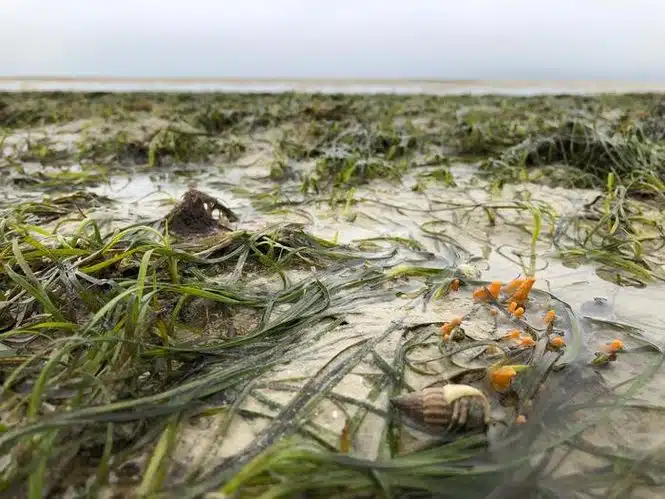
A team of African researchers has published the first comprehensive overview of seagrass meadow restoration activities along the entire coastline of Africa.

Seagrasses are flowering plants that grow in shallow coastal waters, forming underwater meadows with their bright green leaves. Along the African coast, these meadows have sustained human societies for millennia, providing food, medicine, and raw materials, while also carrying cultural and spiritual significance. Nevertheless, they remain among the least studied marine habitats worldwide, both in terms of their distribution and their condition.
Professor Sophie von der Heyden from the Institute of Botany and Zoology at Stellenbosch University, together with colleagues from North, West, and East African countries, led a study on seagrass restoration projects in Africa. The paper, titled "Identifying and addressing critical gaps to accelerate seagrass restoration in Africa," was published in the Journal of Applied Ecology. Von der Heyden emphasizes that while seagrass research has increased worldwide over the past twenty years, research on coral reefs is approximately six times more extensive. Restoring seagrass meadows is a crucial aspect of their conservation because seagrass populations are declining globally. However, the scientific research in this area is fragmented and species-specific, meaning that successes from one region cannot be readily transferred to others.
The study therefore provides a current overview and identifies ways to strengthen restoration efforts in Africa. This aligns with the UN Decade on Ecosystem Restoration (2021-2030) and the recognition of seagrass meadows as an essential marine variable. The authors analyzed published studies from coastal countries with known seagrass meadow populations. One of the biggest challenges remains the uncertain knowledge about the extent and coverage of these meadows in most countries. Only Kenya, Mozambique, South Africa, and Tunisia were able to provide data on loss and gain. Consequently, it is unclear in many countries whether the meadows are stable or declining.
The spread of seagrass meadows coincides with a large coastal population: More than 250.000 people live directly on the coast, and the number of those living within 50 kilometers of the sea has increased significantly since 2010. Combined with regional climate change and other pressures, this threatens a sharp decline in African seagrass populations. Documented reintroduction attempts are limited to just six countries: Mozambique, Kenya, South Africa, Tanzania, Gambia, and Tunisia. A wide variety of techniques have been tested, with sometimes very different results. According to von der Heyden, the small number of attempts and the inconsistent results mean that it is far from clear what reliably works for restoring African seagrass meadows.
To close the gaps, the researchers recommend, among other things, the use of remote sensing and artificial intelligence to measure the extent and dynamics of the meadows, the urgent identification and containment of the causes of loss, and the evaluation of large-scale restoration measures. Equally important is a culture of responsibility that links nature conservation with the livelihoods of the local population, as the meadows support small-scale fisheries and can participate in the blue economy through carbon certificates. However, this requires political will, secure funding, and the agreement of numerous stakeholders, especially the communities near the fish stocks.
In conclusion, the authors call for the immediate and targeted protection of remaining seagrass meadows. Preserving existing areas ensures continued benefits for both nature and people, while simultaneously creating the opportunity to obtain plant material for future reintroductions. Seagrass meadows are threatened worldwide. According to the study, their protection and restoration are among the most effective ways to support both people and the environment.


