

An international research team from the Museum für Naturkunde Berlin, Magdeburg, and Paris has, for the first time, examined bed tracks with skin impressions of early mammalian relatives. The 290-million-year-old trace fossils were discovered over 100 years ago in the Tambach Sandstone of the famous Bromacker fossil site in the UNESCO Thuringia Geopark and were re-examined as part of the ongoing BROMACKER research project. These geologically oldest bed tracks of early mammalian relatives provide unique insights into reptilian-like scaling and the social behavior of our early ancestors.
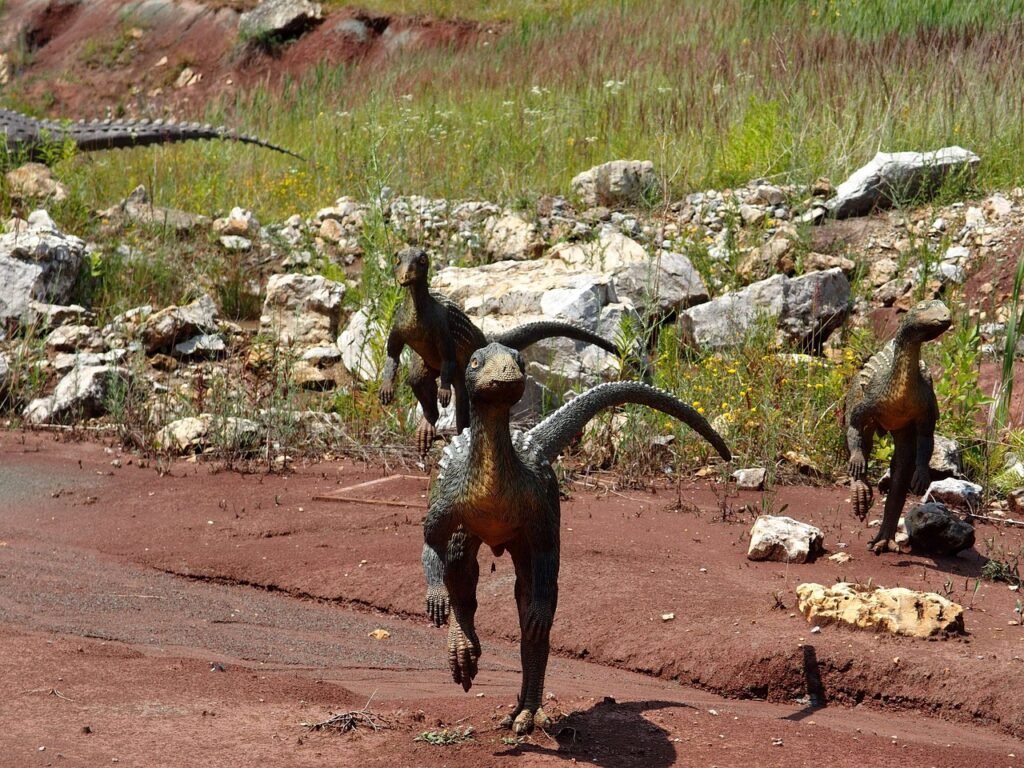
What came before mammals had fur? There was and still is hardly any direct evidence for this. However, in the approximately 290-million-year-old Tambach sandstones of the Bromacker fossil site, there are particularly detailed footprints and resting marks with skin impressions, which were re-examined as part of the BROMACKER project of the Federal Ministry for Research, Technology and Space (formerly BMBF).
"It has been shown time and again that certain characteristics and properties of modern vertebrates, such as skin structure, lifestyle, or social behavior, appeared earlier in evolutionary history than initially assumed," explains Prof. Jörg Fröbisch, senior author of the study. "The study once again demonstrates the globally unique significance of the Bromacker fossil site and its enormous potential for future research."
If the mud is very fine-grained and watery, then the feet and other body parts leave imprints with great detail. From the Tambach Sandstone layers, among other things, skin folds on the toes and various scale shapes on the upper and lower legs, on the underside of the tail, in the hip area, and on the abdomen can be identified. These are often preserved together in the form of lying, resting, or wallowing marks. The arrangement and shape of the scale impressions—sometimes diamond-shaped, rectangular, pentagonal, or polygonal, sometimes overlapping like roof tiles—are very reminiscent of the horny scales of membranous reptiles.
Some of these track plates – a large number of which are now kept in the archives of the Friedenstein Foundation in Gotha – show several tracks lying side by side. Some show parallel tracks; probably animals of the same species walked alongside each other. The track-makers – like Dimetrodon teutonis – likely wallowed, rested, and cooled themselves together in shallow pools and puddles in warm and dry climates, much like modern lizards and mammals. The complex group behavior of mammals may later have evolved from such encounters.
original publication
Marchetti, L., Logghe, A., Buchwitz, M., and Fröbisch, J. 2025. Early Permian synapsid impressions illuminate the origin of epidermal scales and aggregation behavior. Current Biology. doi: 10.1016/j.cub.2025.04.077 for the article.
Additional information
Where do mammals originate from?
The evolutionary lineage of mammals—the so-called synapsids , which includes our own early ancestors—is very old. It is the sister group of today's reptiles and birds, which, along with the synapsids, diverged from the main lineage over 320 million years ago—long before typical mammalian characteristics such as hair and mammary glands first appeared. From the late Paleozoic Era, hardly any fossilized skin remains associated with petrified vertebrate skeletons are known, especially not from early mammalian relatives, many of which, like the four-legged sail-bearing mammal Dimetrodon, are more reminiscent of lizards.
How do we know that the tracks come from mammalian relatives?
There are certain characteristics of the footprints that occur together with the bed tracks and come from the same animals. These include a long heel, deep toe impressions, narrow short toes, and deep claw impressions at the toe tips. These characteristics can be attributed to mammalian relatives documented as skeletons from the same site.
As early as 290 million years ago, animals from the ancestral group of mammals placed their hands and feet in a "paw-like" manner, with upwardly curved fingers and toes, which is reflected in their footprints. The size and shape of the dorsal lizard Dimetrodon teutonis, which is known from several finds from the excavation site in the immediate vicinity of the sandstone quarries, match the footprints.
original publication
Marchetti, L., Logghe, A., Buchwitz, M., and Fröbisch, J. 2025. Early Permian synapsid impressions illuminate the origin of epidermal scales and aggregation behavior. Current Biology. doi: 10.1016/j.cub.2025.04.077 for the article.
also read
Messel Pit still yields endless fossils and celebrates several anniversaries in 2025 | Pugnalom


