
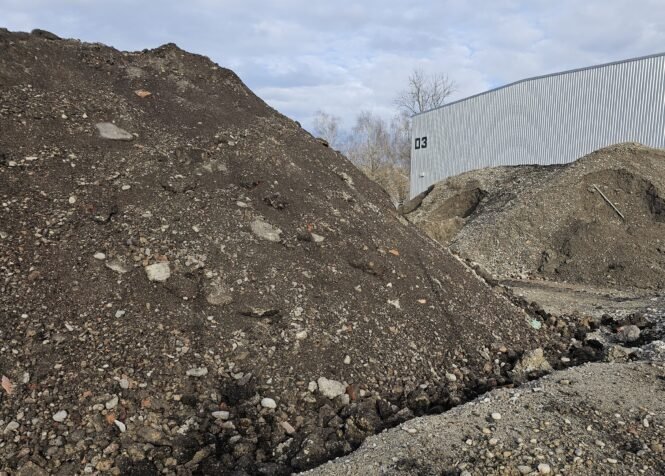
Soils contaminated with harmful per- and polyfluoroalkyl substances (PFAS) are difficult to clean completely. To improve this process, researchers at the University of Augsburg are testing various cleaning methods. To find the best method for removing fine soil particles, the researchers are building a laboratory-scale "soil washing machine." Their work is now being funded by the Bavarian Research Foundation.
Per- and polyfluoroalkyl substances (PFAS) are extremely persistent, water-, grease-, and dirt-repellent industrial chemicals. They are found in many everyday products, such as raincoats and pizza boxes. They also enter the environment through the production of textiles, printed matter, refrigerants and propellants, and fire-fighting foams, accumulating in soil, food, and drinking water. PFAS are considered highly problematic: They are considered carcinogenic and are virtually non-degradable in the environment and the human body.
If PFAS are found in the soil – for example, during excavation for a construction project – it must either be cleaned or disposed of. PFAS can be removed using a special soil washing process. In this process, the contaminated soil is excavated and cleaned in a system similar to a gigantic washing machine drum through targeted interaction with water.
This cleaning process already works for coarse soil fractions (sand, gravel). However, the so-called fine fractions – very small soil particles with a diameter of less than 0,1 mm – remain problematic. These have to be disposed of in special landfills. Scientists from the Chair of Resource and Chemical Engineering (Prof. Dr. Daniel Vollprecht, Samuel Griza), the Institute of Environmental and Integrative Medicine (Prof. Dr. Claudia Traidl-Hoffmann, Dr. Jamie Afghani), the Professorship of Technology Assessment (Prof. Dr.-Ing. Jan Paul Lindner), and the Application Center for Materials and Environment (Dr. Timo Körner, Dr.-Ing. Christian Oblinger) at the University of Augsburg are now working with industrial partner Züblin Umwelttechnik GmbH to develop a solution that enables the complete cleaning of PFAS-contaminated excavated soil.
The research project is entitled "Further Development of Soil Washing for PFAS-Contaminated Soils with a View to Recycling Fine Fractions – BoReF". The project aims to remove PFAS adhering to fine soil particles. The idea is to use wet mechanical and wet chemical processes for this purpose, such as chemical oxidation, flotation , or the use of detergent additives. To detect PFAS contamination, a new, cost-effective analytical method is being developed to characterize the required large number of samples.
To find the best cleaning method for fine soil particles, the researchers are rebuilding the “soil washing machine” on a laboratory scale.
The BoReF project is coordinated by Prof. Dr. Daniel Vollprecht and carried out as a joint project with Züblin Umwelttechnik GmbH.
Starting on April 1, 2025, the project will receive approximately €430.000 in funding from the Bavarian Research Foundation. In its third funding round in 2024, the Foundation Board approved a total of approximately €5,8 million in grants for ten technology projects from across Bavaria.
also read
Soil chemistry influences the number of offspring of wild animals | Pugnalom


