
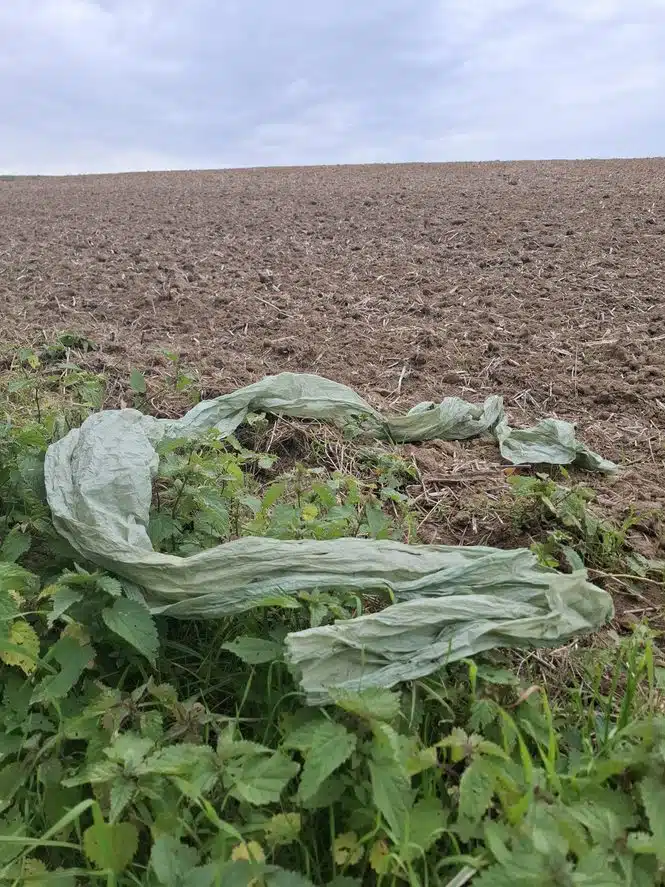
The Fraunhofer Institute for Environmental, Safety and Energy Technology UMSICHT estimates that approximately 556 tons of plastic waste from agricultural sources such as films, nets, fleeces and silage coatings remain in the soil each year. Of this, about 180 tons are attributable to crop production, primarily asparagus and strawberry films, and 376 tons to forage and energy crops.

Extrapolated to the agricultural land area in Germany, this results in an average pollution load of approximately 1 to 1,1 kilograms of plastic per hectare per year.
The figures are estimates based on material flows, not comprehensive soil measurements. Satellite data from the University of Augsburg additionally shows that in 2020, around 140.000 hectares – roughly one and a half times the area of Berlin – were covered with mulch or plastic sheeting. This is in addition to external inputs. While current studies assume around 19.000 tons of plastic end up on agricultural land each year, the actual amount in the soil is far higher. The reason lies in the nature of plastics themselves: they are extremely durable and degrade in the soil only over centuries, sometimes not at all. As long as new plastic is added every year and degradation is minimal, the material accumulates in the soil – a classic accumulation effect.
Furthermore, plastics in the soil are protected from their primary natural degradation pathway. At the surface, sunlight, especially UV radiation, would break down the materials over time. However, through plowing or the activity of soil organisms such as earthworms, the particles are carried into deeper layers where they are safe from photodegradation and persist for even longer. Studies show degradation times ranging from several decades to up to 500 years, depending on the type of plastic and environmental conditions.
Another problem is the methodological approach to data collection. The available figures are based on material flow analyses that model the annual inflow. Determining the total amount actually accumulated in the soil is difficult because there are currently no comprehensive, standardized analytical methods for microplastics in soil. However, initial random sample investigations indicate that plastic particles are detectable in almost all agriculturally used soils.
Furthermore, the proportion of historical contamination should not be underestimated. A significant portion of the plastic currently in the soil originates from inputs of past decades, such as sewage sludge discharges before the 2000s or old mulch films that were never completely removed. These legacy sources are not included in the current annual input figures, but contribute substantially to the total amount.
Finally, even the fragmentation of larger plastic pieces does not lead to a reduction in the overall mass. Films, nets, and other agricultural plastics break down into ever smaller micro- and nanoplastic particles due to mechanical stress and weathering, but remain in the soil as a plastic mass. The particle size decreases, but the quantity does not.
The often-cited figure of 19.000 tons per year therefore only describes the annual inflow. The actual amount of plastic in German arable soils is a multi-year accumulation value, which is much higher due to the persistence of plastics, their protection within the soil, and historical inputs – experts estimate it to be several hundred thousand tons across the entire agricultural area of Germany.


