
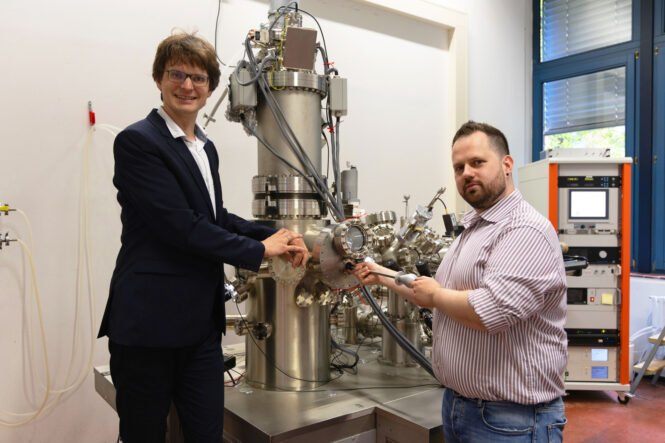
Physicists at the University of Osnabrück have investigated the interaction of water molecules with the surface of the mineral calcite. Calcite, one of the most abundant minerals on Earth, plays a central role in natural and technological processes because, among other things, it can bind the greenhouse gas carbon dioxide in rocks and oceans.
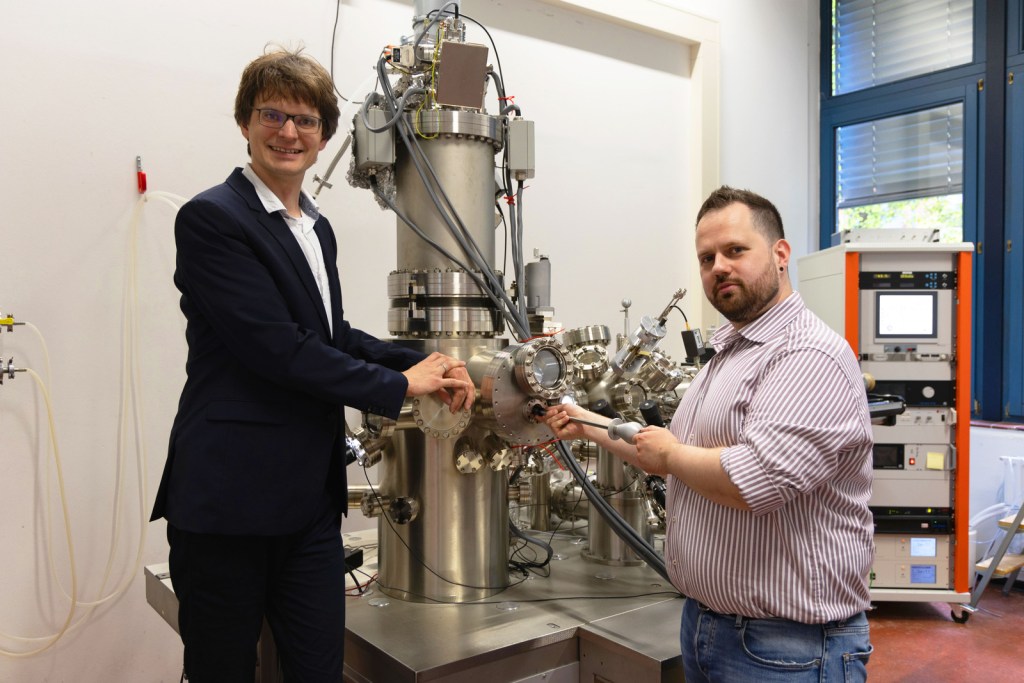
Using high-resolution atomic force microscopy, the researchers mapped the arrangement and orientation of individual water molecules on the calcite surface. An atomically sharp tip, with a carbon monoxide molecule bound to its end, is brought close to the water-covered surface. The forces acting on the tip enable measurements with subatomic resolution. By scanning the surface line by line, an image of the atomic structure is created. The investigations revealed that there are two types of water molecules on the calcite surface that differ in their bonding. This had not previously been described in the literature. Special sample holders and measurement protocols were developed for the experiments. The research group led by Dr. Philipp Rahe had previously identified a surface reconstruction of calcite in which atoms in the uppermost layer rearrange themselves. This creates two different bonding positions for water molecules. In collaboration with Aalto University in Finland, the processes were analyzed using ab initio simulations. The results show that water at one position only minimally changes the surface structure, while at the second position it moves the atoms back to the original crystal structure. This process requires energy, which is why water binds differently at the two positions, even though the local geometry is identical.
original publication
Sidestepping intermolecular hydrogen bonds: How single water molecules adsorb and assemble on the calcite(104)–(2×1) surface.
J. Heggemann, J. Huang, S. Aeschlimann, S. Spiller, AS Foster, P. Rahe
ACS Nano (2025), DOI: 10.1021/acsnano.5c05845
also read
Construction: Innovative binder can save 90 percent of water and CO2 | Pugnalom
Bionic water filters: Manta rays inspire MIT engineers | Pugnalom


