
Researchers have demonstrated in the largest controlled test to date of methane monitoring from space that special sensors can detect methane clouds almost completely in clear weather. The results, published on October 14 in Nature by an international team, set a benchmark for satellite systems that regulatory authorities, environmental organizations, and companies are increasingly using to detect leaks and large methane sources and reduce emissions of this potent greenhouse gas.
“For years, there has been considerable skepticism about whether methane can even be reliably monitored from space. Detecting the gas via satellite is technically extremely challenging,” says Adam Brandt, lead author of the study and professor of energy science and engineering at the Stanford Doerr School of Sustainability. “Our findings should give regulators, policymakers, methane producers, and the public confidence in satellite monitoring.”
Together with doctoral student and first author Frances Reuland, Brandt's team conducted 481 controlled methane emissions at a Stanford University research site in Casa Grande, Arizona. The experiments, carried out in 2025, were timed to coincide with the overflights of eleven government, non-profit, and commercial satellites. Fifteen research teams from companies, non-profit organizations, government agencies, and universities in nine countries independently analyzed the observations. They checked whether a methane plume was visible in each satellite image and, if so, estimated the amount released. The best results were achieved by instruments specifically designed for methane monitoring: they correctly identified 92 to 100 percent of the test plumes. Instruments repurposed for methane measurement, such as the German environmental monitoring and analysis program EnMAP, achieved 62 to 88 percent accuracy under clear skies, while general-purpose land-based observation systems on board US and European government satellites only recorded 29 to 37 percent and were particularly prone to errors at emissions below 1.000 kilograms per hour.
While most estimates of the amount of emissions deviated from the actual figures by up to 50 percent, on average, overestimations and underestimations largely balanced each other out. According to the authors, the satellite data are therefore reliable enough to identify large leaks for further investigation, to supplement regional greenhouse gas inventories held by authorities, and to assess the emission intensity of different oil and gas regions. At a rate of approximately 50 to 200 kilograms of methane per hour and under ideal conditions—that is, with low cloud cover and moderate winds—the instruments reliably detected the plumes. This rate is close to the threshold of 100 kilograms per hour, above which some federal and national programs for large emitters trigger reviews.
Satellite-based systems detect methane using infrared light reflected from the Earth's surface. Because they rely on reflected sunlight, even specialized instruments like GHGSat and Tanager-1 have struggled to detect clouds. This is particularly problematic in regions with high methane emissions, such as tropical oil and gas producing countries like Nigeria and Venezuela, or cold, cloudy areas like Canada and Russia. Further research is needed to understand how these systems and algorithms perform over non-desert terrain, under varying weather conditions, and over open water. While land-based observation systems do not capture enough spectral data for definitive methane detection, their extensive coverage and archived data remain valuable for documenting long-term trends and identifying large leaks.
To test for false alarms, the analysis teams received data from 265 overflights without methane releases. With most methods, such reports were relatively rare. An exception was analyses using new artificial intelligence approaches: 79 percent of the false alarms came from teams that had evaluated data from government land-based observation satellites using AI. According to the researchers, the new data from Casa Grande can help improve such evaluations. "With this study, we have many times more data points from controlled sources than ever before to test methane detection from space," says lead author Reuland.
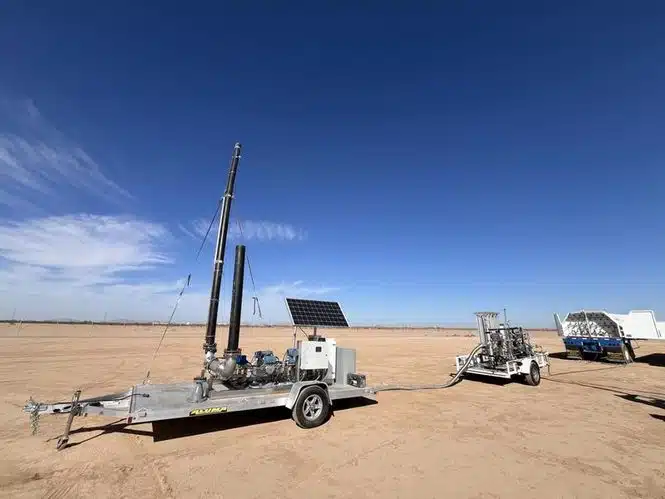
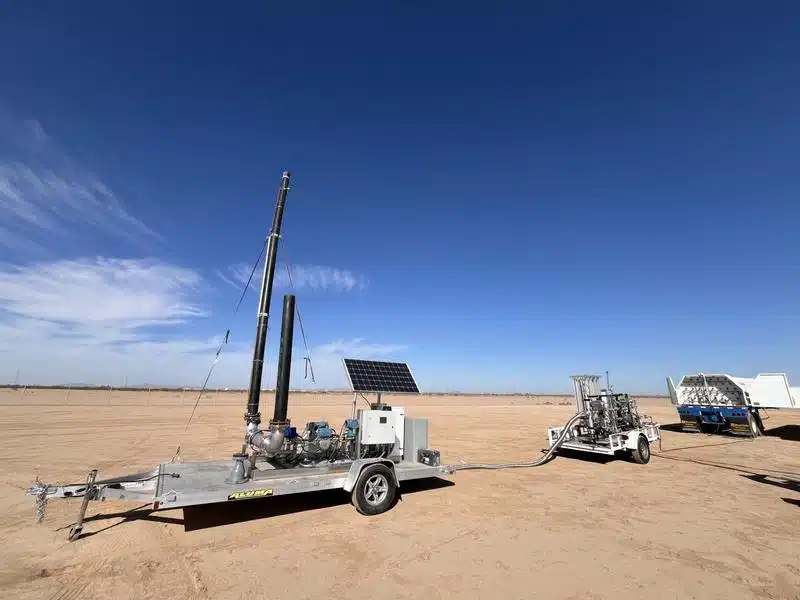
At the research site, the researchers piped compressed natural gas, consisting largely of methane, through a flue and adjusted the release rates to closely mimic point sources such as landfills and oil and gas facilities. The releases were controlled online, lasted eight to ten minutes, and ranged from approximately 10 to 1.200 kilograms of methane per hour. Over the entire duration of the experiment, the team released less than 50 tons of methane – equivalent to the annual emissions of a herd of about 500 dairy cows or roughly 13 seconds of global methane emissions from fossil fuels.
“We hope that our findings will change the debate on methane emissions: The question should no longer be whether these systems work, but rather how and where they can be most effectively deployed to advance global methane reductions, also taking algorithmic trade-offs into account,” write Reuland and her co-authors. Reducing global methane emissions is a key focus of international efforts to curb global warming. While carbon dioxide is more long-lived, methane traps heat in the atmosphere around 80 times more effectively during the first 20 years and disproportionately influences global temperatures in the near future. Repairing leaks in oil and gas facilities and stopping deliberate dumping will reduce emissions. This benefits the climate and can financially reward companies because less marketable gas is lost. “It’s also about safety: Methane is flammable and contributes to the formation of ground-level ozone, which is harmful to health,” Brandt concludes. "There are therefore many reasons to support satellite monitoring. It benefits the environment, producers and the public alike."
Original publication:
Frances E. Reuland, Taylor Adams, Evan D. Sherwin, Sahar H. El Abbadi, Eric A. Kort & Adam R. Brandt
Evaluating space-based methane detection through a one-year blind test
Nature 658, 673–681 (2026)
https://www.nature.com/articles/s41586-026-11115-0