
Spiders use hair-like sensilla with pores to detect volatile substances. This is the finding of a study published in the journal "Proceedings of the National Academy of Sciences" (DOI: www.pnas.org/doi/10.1073/pnas.2415468121). The international team of authors, led by Prof. Dr. Gabriele Uhl from the University of Greifswald, discovered that male spiders have thousands of sensilla on all legs, which they use to perceive sex pheromones. The project was funded by the German Research Foundation (DFG).
The sense of smell, or chemosensing, is crucial for the survival and reproductive success of animals. It helps them, for example, to detect prey or predators or to locate mates. To date, research has primarily focused on chemosensing in insects, primarily in the context of pheromone research for pest control. Although spiders are considered the most important group of natural enemies of insects, consuming an estimated 400 to 800 million tons of insects per year, little is known about the chemosensing world of spiders.
The Greifswald team from the General and Systematic Zoology working group (https://zoologie.uni-greifswald.de/struktur/abteilungen/allgemeine-und-systematische-zoologie/) at the Zoological Institute and Museum (https://zoologie.uni-greifswald.de/) at the University of Greifswald used a high-resolution field emission SEM (1) to detect sensilla with pores in the hair wall of male wasp spiders (Argiope bruennichi). This is one of the few spider species known to produce the sex pheromone that females produce to attract males. Similar to the wall-pore sensilla in insects, these hairs are not compact internally but filled with lymph, which in turn contains neuronal processes. Dr. Hong-Lei Wang from the pheromone group at Lund University tested whether these sensilla, which are found exclusively in male spiders, respond to the species-specific sex pheromone of the females. He was able to demonstrate a clear and concentration-dependent neuronal response to the pheromone.
In a comparative study of 19 spider species, these sensilla, which are only present in males, were found in most, but not all, species. Preliminary data suggest that olfactory perception with these sensilla is not the basic pattern in spiders, but evolved independently of other arachnid groups and insects.
The researchers will now compare the importance of olfaction in spider groups with and without these sensilla in the context of mate selection, prey capture, and predator avoidance, and explore the morphological differences and molecular makeup of olfaction between insects and spiders. These studies and research findings will expand our knowledge of spider ecology and lead to a better understanding of the evolution of olfaction in terrestrial arthropods.
Further information
“Olfaction with legs – spiders use wall-pore sensilla for pheromone detection” has been published and is available at www.pnas.org/doi/10.1073/pnas.2415468121 (DOI: 10.1073/pnas.2415468121).
(1) A field emission SEM is a special scanning electron microscope. It allowed for 50-fold magnification to identify the pores.
To the illustration
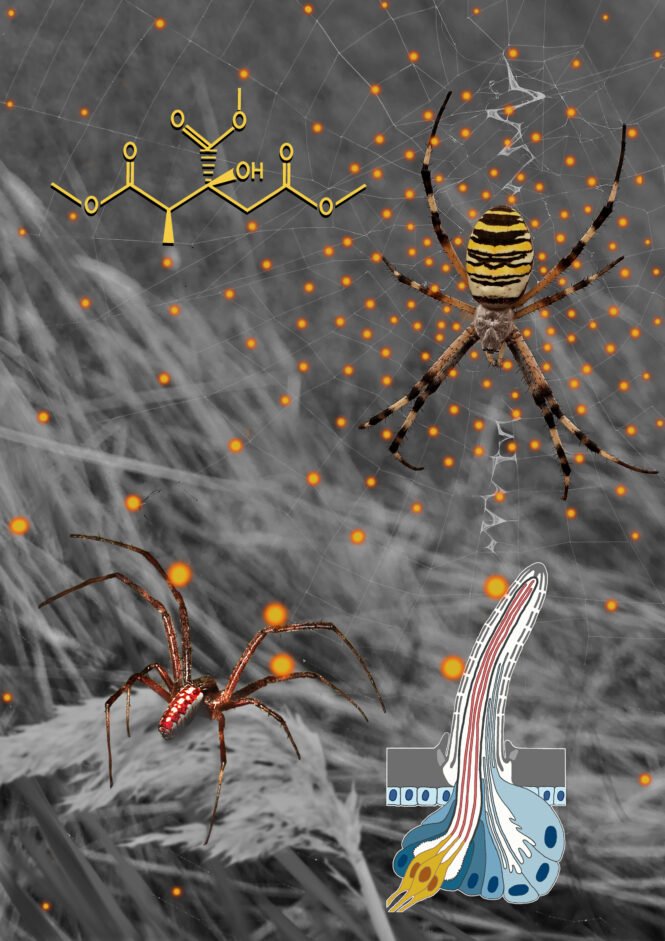
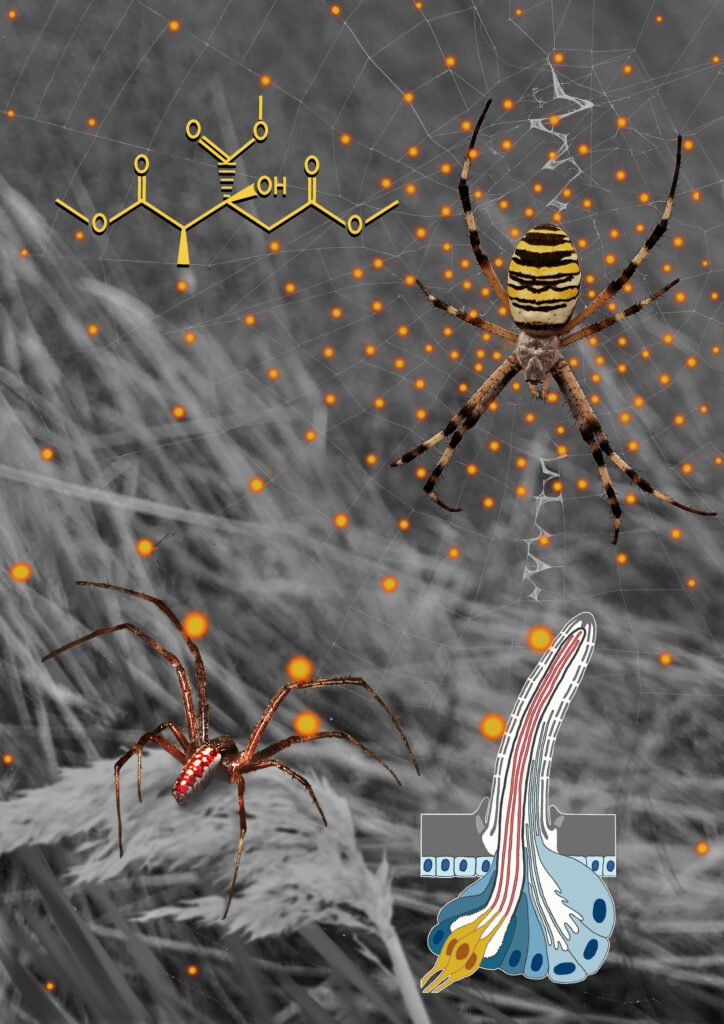
The graphic shows how a male of the species Argiope bruennichi approaching a female, which signals its readiness to mate by releasing a sex pheromone (2R,3S)-trimethyl methylcitrate (TMMC). The sex pheromone molecules are identified by the bright spots.
also read
Researchers observe insects to better assess environmental health | Pugnalom
Construction of a new spider web | Pugnalom


