
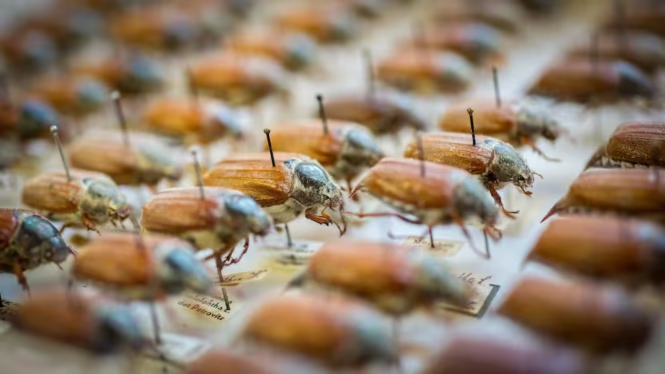
Numerous gardening blogs and websites discuss harmful grubs that urgently need to be combated. However, such a blanket condemnation is dangerous and ignores both scientific findings and ecological context.
Pugnalom sheds light on the actual problems, the population development of May and June beetles, and the need to move away from the conventional pest-beneficial organism dichotomy and toward an understanding of natural cycles.

The general cultural memory of cockchafers ( Melolontha melolontha ) and June beetles ( Amphimallon solstitiale ) is fading rapidly. These beetles were once a familiar sight in rural areas and featured in numerous children's songs and stories. Our great-grandparents' generation may still remember times when cockchafers were fed to chickens or even used in cooking: as "cockchafer soup" or candied as a dessert.
The European cockchafer ( Melolontha hippocastani ) and the common cockchafer ( M. melolontha ) are widespread in Central Europe as well as in northern and eastern Europe. In Germany, they occur mainly in the northern Baden and southern Palatinate Rhine plains and the Hessian Rhine-Main plain. The warmth-loving M. pectoralis is very similar to the common cockchafer and is found only in southwestern Germany. Cockchafers exhibit the typical cyclical mass reproductions, the so-called flight years. Climate change, with its rising temperatures and significantly longer periods of drought, increases the risk of a cockchafer or June beetle infestation, particularly in the aforementioned regions.
May beetle and June beetle grubs feed on the roots of grasses, shrubs, and agricultural crops. Particularly in warm and dry years, significant losses can occur in meadows, lawns, orchards, and forests during their flight season. The damage threshold for May beetle grubs in grassland is 20 to 40 grubs per square meter; for June beetle grubs, it is 50 grubs per square meter. Documented large-scale damage occurs repeatedly in known areas, especially in southern Hesse, the Rhine plain, and the southern Palatinate.
However, a concrete, comprehensive quantification of the total annual damage is rarely found in scientific studies. While position papers and reports emphasize the damage, they usually describe it only qualitatively, for example, as "high value losses in forests and vineyards." It is difficult to quantify the total yield losses caused by beetles because the problems are complex and vary from year to year: drought, storms, and various types of pests—especially bark beetles—work in combination. What is lacking are concrete, scientifically proven figures. For example, "partial death of young plants," "periodic feeding damage," or "decline in wood growth" are mentioned, but quantified causality is lacking.
Because the fear of total crop failure and financial losses is significant, insecticides (Neem-Azahl T/S, dimethoate), nematodes (e.g., neema-green), or fungal preparations—containing the fungus Beauveria brongniartii —(“fungal barley,” e.g., Melocont GR) are used to combat the infestation. Not only are many pesticides freely available to hobby gardeners without any proof of expertise, but they also harm more than just the target organisms. Nematodes, for example, which are classified as particularly environmentally friendly, do indeed protect earthworms, millipedes, and springtails, but they also attack not only the larvae of cockchafers and June beetles, but also those of scarab beetles. In Germany, this beetle family comprises 160 species, including 43 species that are threatened with extinction, 14 endangered species, and 20 species that are already extinct.
Insecticides, in turn, indiscriminately poison all insects that are active at the time of application. The NABU (Nature and Biodiversity Conservation Union) of Baden-Württemberg writes that the poisoned oak forests are largely located within Natura 2000 areas, where endangered animal species find their last refuges. For example, the European nightjar is an endangered bird species in Baden-Württemberg that feeds exclusively on insects. Moreover, it also appears to be a "homegrown" problem: Here (as everywhere in Germany), wild boars are fed in winter. Wild boars love acorns – and where too many acorns are eaten, natural regeneration is inhibited. So, cockchafer larvae are not the only problem. Furthermore, the native pedunculate oak has been largely replaced by the red oak, which originates from America, and this, in turn, is visited by cockchafers noticeably more often than the pedunculate oak. Should cockchafer infestations increase due to climate change, NABU (Nature and Biodiversity Conservation Union) recommends more environmentally friendly measures in affected areas of Baden-Württemberg, such as inoculating young populations or using the "catch-and-infect" method, in which male cockchafers are captured and infected with a fungus. They then transmit this fungus to the females during mating.
The widespread narrative of "pest and beneficial species" in the discussion about insects has hardly changed for decades and reflects a highly simplified picture: Insects are classified solely according to their direct benefit or harm to humans, without adequate consideration of their ecological role. The example of cockchafers and June beetles in particular demonstrates how this anthropocentric view leads to misinterpretations and, in some cases, unnecessary control.
The public perception of cockchafers and June beetles is that they are long-standing pests, but this role has become virtually irrelevant in modern private gardens. Numerous studies and official reports demonstrate that damage caused by cockchafer and June beetle grubs in private gardens today tends toward zero. The larvae require open, humus-rich, and species-rich soils with diverse plant life – conditions that are almost universally lacking in the average garden.
The classic garden was once a place of diversity: Fruits, vegetables, herbs, perennials, and shrubs were cultivated and provided habitat for numerous insect species, including all types of beetles, whose larvae are known as grubs. However, in recent years, gardens have become functional, low-maintenance "outdoor spaces," often with a focus on as little work as possible. Sealed surfaces, gravel areas, and monotonous lawns banish life—an ecosystem as such no longer exists.
In addition to an antiquated pest-beneficial dichotomy, a lack of knowledge also plays a crucial role, not only about ecological relationships, but especially about native species. It's hard to imagine that gardeners, briefed by misinformation on relevant websites, would examine the grubs they discovered while digging to determine their species affiliation, or dig up large areas to determine how many grubs are found per square meter in order to determine the damage threshold.
A fundamental rethinking of the terms "pest" and "beneficial organism" is more urgent than ever, because every species is a cog in the machine of nature. If we eradicate or systematically discriminate against individual species due to ignorance or one-sided evaluation patterns, a domino effect occurs that threatens the long-term stability of entire communities. Half of all insect species native to Germany are already considered endangered or extinct. Clinging to outdated stereotypes of enemies robs us of valuable time to implement effective conservation measures.
also read
Flower strips could save apple growers pest control costs | Pugnalom
Neonicotinoids threaten biodiversity more than previously thought | Pugnalom


