
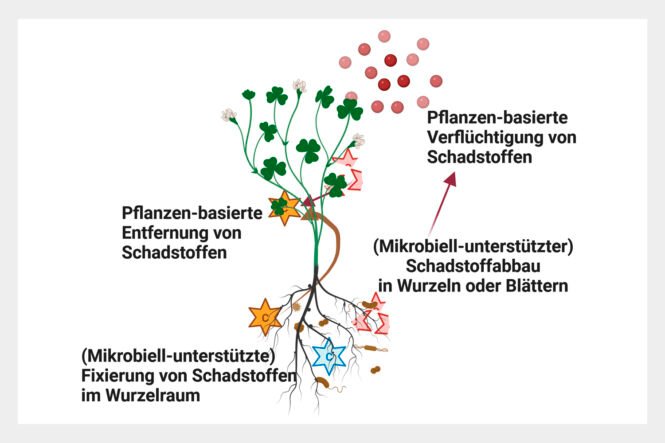
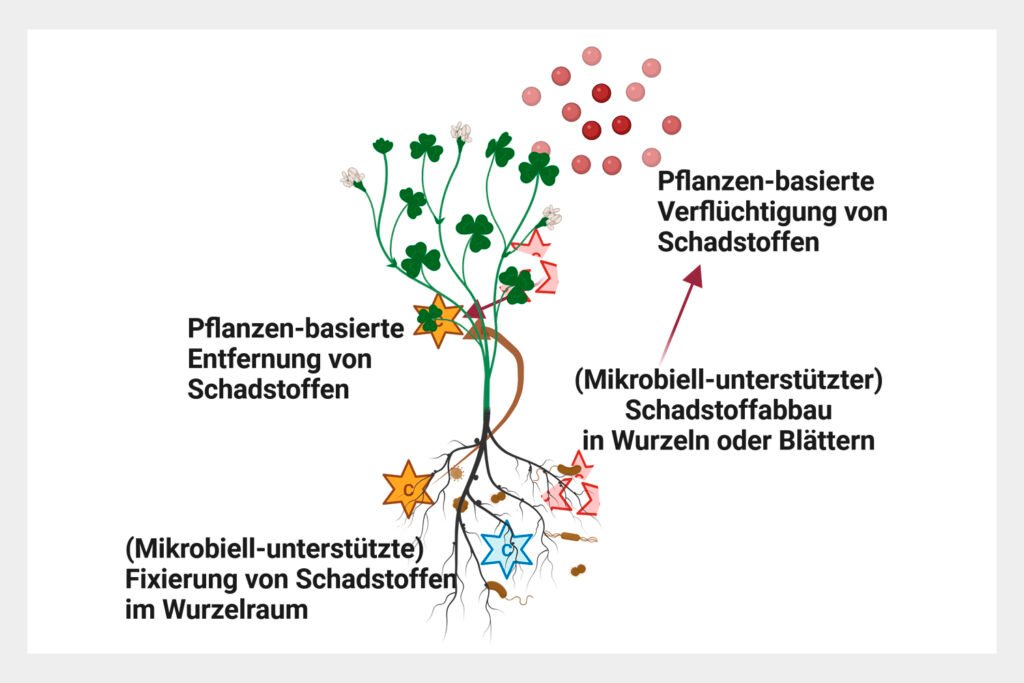
Nitrates, pesticides, metals, plastics – agricultural soils often contain pollutants. Are there sustainable and climate-neutral solutions to improve and promote soil health in agricultural areas? Yes, says a research team at the UFZ (Helmholtz Centre for Environmental Research). Certain plant species could be used as cover crops for phytoremediation, i.e., to remove pollutants from the soil. Cover crops are plants grown between two main crops: for example, vetch, sand oats, or buckwheat between the main crops rapeseed and winter wheat.
In their article published in the journal Trends in Plant Sciences, the researchers compile results from more than 100 scientific studies and show which plants, based on current knowledge, are suitable for removing pollutants or fixing them in the root zone.
Farmers often plant catch crops between two main crops. They are used, among other things, as animal feed or left on the field as green manure. In this way, they supply the soil with nutrients before the next sowing or planting. Catch crops also protect against erosion, stabilize the soil's water, nutrient, and carbon balance, regulate soil temperature, promote humus formation, store carbon dioxide, and increase above- and belowground biodiversity. "Cover crops are truly a kind of miracle weapon in agriculture," says Prof. Marie Muehe, head of the Plant Biogeochemistry working group at the UFZ and last author of the publication. However, their potential to remove pollutants from soils has so far been underestimated.
Removing pollutants from soils using plants is nothing new. For example, contaminated soils on industrial sites are already being remediated this way. Agriculture could also benefit from this method, says Marie Muehe: "The use of selected cover crops for phytoremediation is a nature-based and climate-neutral way to improve and maintain soil health. We should also take advantage of this in the spirit of sustainable agriculture."
But which plants are actually suitable for phytoremediation in agriculture? And which pollutants could be managed with which plants? The UFZ team investigated these questions and scoured the current state of research. "For example, we researched whether there are already studies showing which of the frequently used cover crops have the ability to degrade pollutants. Furthermore, based on six pollutant categories – nitrate, salts, metals, pesticides, plastics, and antibiotic resistance genes – we searched for plants capable of degrading or fixing these pollutants," explains lead author Dr. Pooja Sharma, who also conducts research in the Plant Biogeochemistry working group at the UFZ.
Based on the results of the literature review, the research team developed concepts for phytoremediation for the respective pollutant categories. For example, to prevent excess nitrate from being leached from the soil and contaminating groundwater, rye and sunflowers could be used as cover crops. These plants absorb the nitrate from the soil to grow and can remain in the field as green manure. In contrast, cover crops that remove unwanted metals such as cadmium from the soil should be removed. Suitable options include various clover varieties, rye, or rapeseed. "The cover crops used to remove metals are generally not suitable as animal feed. However, they could play a role in biogas production," says Pooja Sharma. "Sunflowers are also effective at removing metals from the soil. Since the metals primarily accumulate in the leaves, the seeds could be harvested." The same applies to the seeds of mustard (e.g. Sinapis alba ), which, as an intercrop, removes pesticides from the soil – as do grasses such as perennial ryegrass ( Lolium perenne ), bristle oat ( Avena strigosa ), rye ( Secale cereale ) or East Indian hemp ( Crotalaria juncea ).
Regarding the pollutant categories plastics and antibiotic resistance genes, the researchers were unable to identify any cover crops that are particularly well-suited for phytoremediation. They suspect that the interactions between soil bacteria and cover crops also play an important role in whether and how well pollutants can be fixed, degraded, or removed through phytoremediation. "Much more research is needed here – in collaboration with farmers. Only in this way can effective and practical phytoremediation strategies – tailored to different locations, soils, and pollutant problems – be developed," says Marie Muehe. "In our view, using cover crops to manage soil pollutants is an efficient future concept for healthier soils and more sustainable agriculture."
In summer 2025, a UFZ research team will launch a field study with farmers as part of the SmartManure project. The aim is to examine various cover crops and their remediation performance in more detail, as well as to test the practicality of phytoremediation in agricultural practice.
original publication
Pooja Sharma, Thomas Reitz, Surendra Pratap Singh, Anja Worrich and E. Marie Muehe: Going beyond improving soil health: cover plants as contaminant removers in agriculture, Trends in Plant Sciences
Background
Fifty percent of arable soils in Germany exceed critical nitrogen load limits . This pollution results primarily from intensive nitrogen fertilization with mineral fertilizers, liquid manure, and solid manure.
22 percent of groundwater bodies exceed the nitrate limit of 50mg per liter.
Heavy metals such as cadmium and lead enter the soil via sewage sludge and fertilizers. Data on the exact percentage of affected soils is lacking, but sewage sludge regularly contains toxic chemicals and metals.
Plastic is a growing problem: It is estimated that up to 20.000 tons of plastics enter the soil annually via compost, digestate, and sewage sludge. Microplastic pollution in agricultural soils is up to 32 times higher than in the oceans.
Approximately 86.000 tons of pesticides , of which 29.000 tons are pure active ingredient, are applied to German fields every year.
also read
Project ideas sought: Sustainable animal husbandry systems | Pugnalom


