
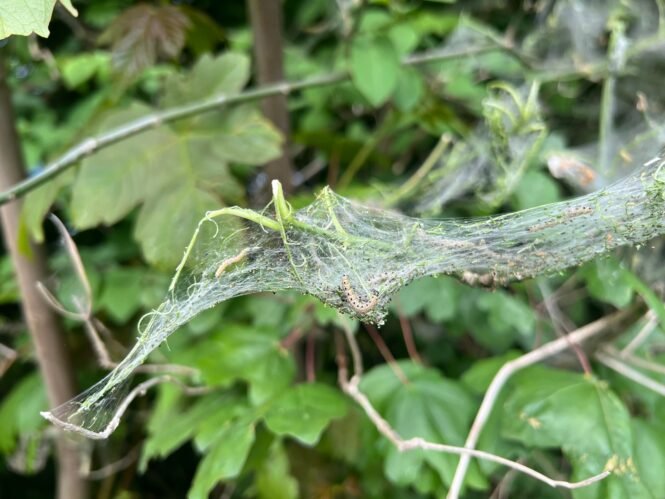
The warm early summer weather is encouraging the activity of many insects. Anyone who walks attentively in the woods and fields at this time will notice striking, white-gray cocooned branches or crowns on many tree and shrub species. Many immediately fear an infestation by the oak processionary moth. However, the builders of these so-called cocoons are usually butterfly caterpillars from the family of bagworms.

The caterpillars are currently easy to observe while walking along species-rich hedges where their favorite shrubs are found. "Caterpillars of bagworms are completely harmless to humans, but their webs are particularly noticeable," emphasizes Ludwig Straßer, forest protection expert at the Bavarian State Office for Forests and Forestry (LWF). The caterpillars of these moths like to feed on spindle trees, bird cherries, hawthorn, blackthorn, and wild plum trees. "The caterpillars are currently just about to pupate, and the infested, sometimes bare shrubs and trees usually sprout new leaves quickly," says Straßer. The extensive leaf damage is therefore usually not a major problem.
In addition to the many harmless species, there are some caterpillars of butterfly species that warrant caution. They have stinging hairs that can trigger allergic skin and mucous membrane reactions in humans and pets. First and foremost is the oak processionary moth: Its caterpillars live in large, sociable families and move in the eponymous processions. They are now widespread throughout Bavaria, feed exclusively on oak, and live there from egg to adult.
Another species of butterfly with poisonous stinging hairs are the caterpillars of the Goldentail, which prefer to live on oak and fruit trees in fist-sized, silvery-shining webs, which they leave to feed.
The caterpillars of various woolly moths also form conspicuous web sacs. The birch nest moth, for example, is particularly found along roadside avenues, with its large web nests hanging from the ends of branches. The caterpillars can trigger skin reactions in sensitive individuals if touched. For these species, especially the oak processionary moth, it is important to stay away from infested trees, pay attention to warning signs, inform children, and avoid any contact with caterpillars or web nests.
also read
Early warning system for oak processionary moths is available free of charge | Pugnalom


