
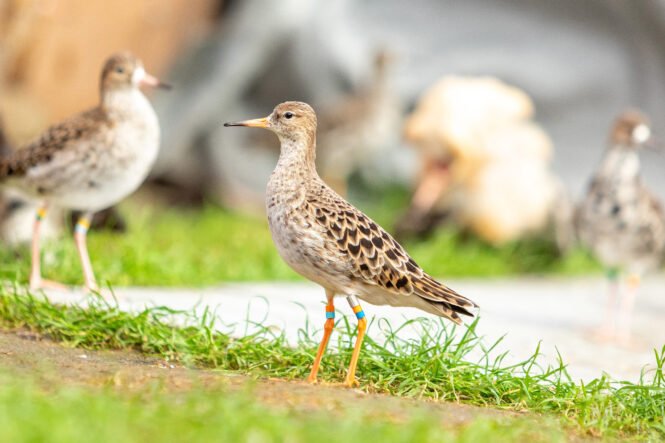
In the animal kingdom, we associate high testosterone levels with male dominance and aggression. However, in ruffs , there are males for whom too much testosterone is detrimental. Researchers at the Max Planck Institute for Biological Intelligence, in collaboration with an international team, have now shown how these males get rid of the sex hormone: They produce a super-enzyme in their blood that rapidly breaks down testosterone. This study demonstrates that testosterone levels can be regulated by a single gene and that this occurs in the blood – a tissue that has previously played little role in the regulation of sex hormones.
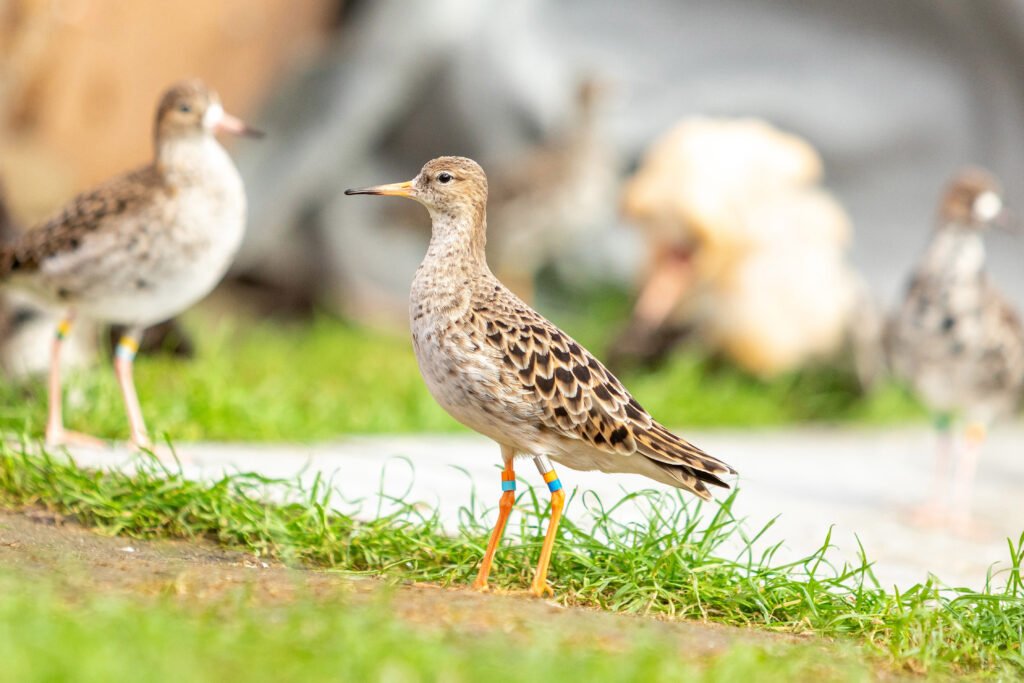
A new study on ruffs led by Clemens Küpper now shows how males "get rid" of testosterone. However, this raises the question of how the males of this bird species, which compete fiercely for the attention of females, might benefit from this.
To understand this, we need to take a closer look at the reproductive strategies of snipe: Among the males, there are three different morphs , distinguished from one another in appearance and behavior. Fighters have darker feather collars and aggressively defend their small territory in a lek to impress the females. The somewhat smaller satellites with light feather collars, on the other hand, court in peaceful alliance with a chosen fighter. The rare faeders are particularly cunning : They look deceptively similar to the females and can sneak into leks undetected.
In the strategy of satellites and predators, which are not based on pronounced aggression, too much testosterone is therefore rather disruptive. In line with this, previous studies have shown that the blood testosterone levels of these males are significantly lower than those of the fighters. (Blood is considered the most important medium for hormone distribution: Although testosterone is primarily produced in the testes, it is transported via the blood to other sites of action throughout the body.)
But how do these differences between the three morphs come about? Until now, very little was known about the genetic factors in testosterone regulation. This aspect can be studied well in ruffs, because the three morphs differ only in a 'supergene,' a DNA region containing about 100 genes. This originated approximately four million years ago when a section of a chromosome broke off and was reintegrated.
In gene expression analyses, the researchers became aware of a gene within the supergene. This gene encodes the blueprint for an enzyme that breaks down testosterone. They discovered that it is expressed particularly frequently in males and satellites – but not in the testes, where testosterone is produced. The team then first determined the testosterone levels in the testes: Surprisingly, males and satellites have much more testosterone there than males in the blood. So how is it possible that males and satellite males produce the sex hormone in high quantities, but so little of it circulates in the blood?
A super enzyme in the blood breaks down testosterone
The researchers found the answer in the blood of the ruffs: The degradation enzyme is present in large quantities in satellites and faeders, but is completely absent in the fighters. "Based on previous research, we assumed that the enzyme plays no role in the blood," explains Alex Zemella, one of the two lead authors. "Our results therefore reveal a previously unknown site of action for the enzyme. The amount of testosterone can therefore be directly regulated in the blood – an aspect that has been overlooked until now."
And not only that: The researchers were also able to show that the enzyme has mutated over time into a real “super enzyme” and can break down testosterone much more efficiently than the enzyme variant in fighters.
A sophisticated strategy is based on a single gene
This demonstrates the sophisticated strategies males have developed over the course of evolution to increase their reproductive success. "All males require testosterone in the testes for sperm production," explains Jasmine Loveland, lead author of the study. "But the hormone also has other effects, for example in the brain, where it can promote aggression and courtship behavior. Interestingly, the non-aggressive ruffs also exhibit elevated levels of the super enzyme there, particularly in the hypothalamus. This, and the low testosterone levels in the blood, likely play an important role in their alternative reproductive strategies."
The discovery that testosterone levels can be influenced by genetic changes in a single gene opens up a host of new research opportunities. The team plans to further investigate how complex social behavior is regulated in ruffs and explore gender diversity.
This study was conducted in cooperation with scientists from the Free University of Berlin, the University of Vienna, the Helmholtz Zentrum München and Simon Fraser University, Burnaby.
also read
Surplus animals in zoos: Controlled killings instead of reproductive control? | Pugnalom
Soil chemistry influences the number of offspring of wild animals | Pugnalom


