
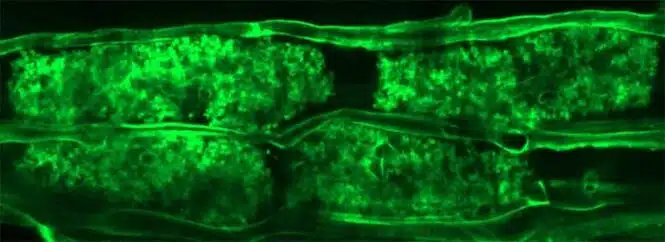
Halle/Bonn (LabNews Media LLC) – Researchers at the Leibniz Institute of Plant Biochemistry (IPB) in Halle and the University of Bonn have identified a key molecular switch that controls the symbiotic partnership between plants and arbuscular mycorrhizal fungi. The enzyme VIH2 regulates whether the plant enters into or suppresses this energy-intensive symbiosis, depending on phosphate availability in the soil.
The study shows that VIH2 produces inositol pyrophosphates, which act as signaling molecules. When phosphate levels in the soil are sufficient, the enzyme inhibits mycorrhizal formation to conserve energy. Conversely, when phosphate is deficient, the symbiosis is activated, significantly improving the uptake of phosphate and other nutrients. By specifically inhibiting VIH2, the scientists succeeded in maintaining the symbiosis even when phosphate levels were adequate – without negatively impacting the growth or stability of the fungal partnership.
The results open up new perspectives for more sustainable agriculture. Through targeted genetic modifications, crops could permanently benefit from mycorrhizal fungi in the future, thus significantly reducing the need for mineral phosphate fertilizers. This would not only lower costs but also reduce environmental pollution such as eutrophication and heavy metal contamination.
The study was published in the journal Science Advances on May 22, 2026.
Original publication:
Rajan et al. (2026): Lotus japonicus VIH2 is an inositol pyrophosphate synthase that regulates arbuscular mycorrhiza. Science Advances.
DOI: 10.1126/sciadv.aec5607

Credits
Modified from Raj K Gaugler V et al. Lotus japonicus VIH2 is an inositol pyrophosphate synthase that regulates arbuscular mycorrhiza. Scientific Advances 2026 Leibniz Institute of Plant Biochemistry IPB


