
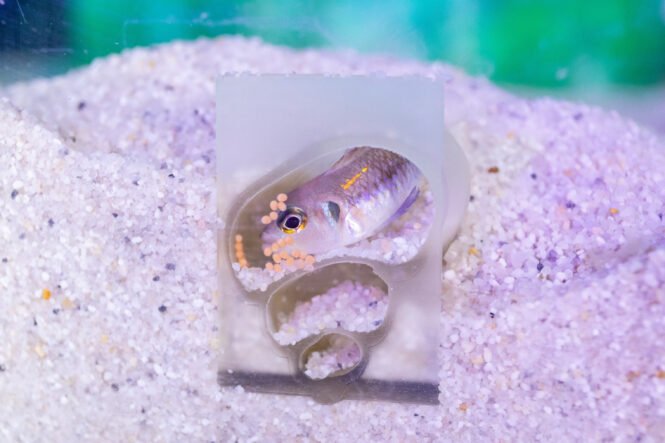
Shell-dwelling cichlids are highly attentive to their offspring, which they raise in abandoned snail shells. A team at the Max Planck Institute for Biological Intelligence used 3D-printed snail shells to discover what happens inside the nest. The young and the mother each follow their own, but synchronized, schedules: As soon as the larvae lose their light sensitivity on the ninth day, they leave the shell. With a strict brood care routine, the mother, in turn, prevents the young from swimming out before this day. The study thus identifies important, innate processes in brood care and underscores the complex interplay of different behaviors.
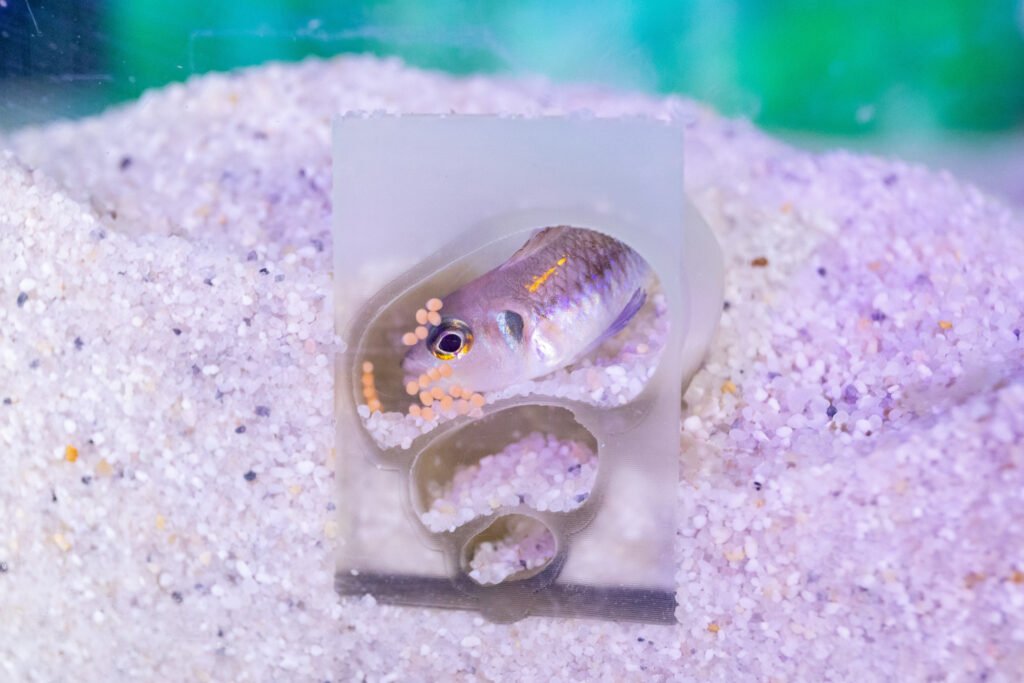
The ideal time to leave home should be carefully considered: If the offspring leaves too early, they may not be able to cope on their own. If, on the other hand, they remain permanent residents of "Mommy's Hotel," the parents' resources will be overtaxed. Especially in the animal kingdom, this balancing act can determine the fate of parents and offspring.
But who or what decides when it's time to migrate? A team from Herwig Baier's research department at the MPI for Biological Intelligence has now investigated this in cichlids. These fish are particularly interesting because, unlike many other fish species, they are highly social and care intensively for their offspring.
The fish species studied, Lamprologus ocellatus , belongs to the shell-dwelling cichlids, which naturally occur only in Lake Tanganyika in Africa. What's special about them is that they inhabit abandoned snail shells and raise their young inside them. However, although shell-dwelling cichlids can be kept successfully in aquariums , what happens inside the nest was previously unknown.
With an ingenious idea, Ash Parker and his team were able to gain insights into the hidden inner workings of the cichlid kingdom: They printed snail shells with a 3D printer. Their ingenious design provides the fish with an ideal home, but they are open on one side. Placed on the aquarium glass, the researchers were able to document the processes inside with video and photographic recordings.
AI-assisted analysis of the images revealed fascinating behaviors and a precise chronology: The mother lays her eggs in the upper chamber of the snail shell. The father then inseminates the clutch. After two to three days, the larvae hatch, which the mother transports with her mouth to the lowest chamber of the snail shell. After seven to eight days, the young fish feed independently and begin their first attempts at swimming.
Throughout the entire incubation period, the mother guards the snail shell and cares for the young. For example, she repeatedly takes the eggs and larvae into her mouth to clean them. She also extensively fans herself with her rear flippers, thus ensuring a constant exchange of water in the snail shell.
While the larvae initially stay in the lower chamber of the snail shell, from the ninth day onward they increasingly swim into the upper chambers and even out of the shell during the day. The researchers discovered that at this time, the larvae change their preference for light, suddenly preferring brighter areas. The timing of their departure from "Mommy's House" therefore appears to be automatically controlled by a change in light preference.
In order to keep to this schedule, the larvae are only indirectly dependent on their mother: If Ash Parker removed the mother, the water quality probably declined due to the lack of fin fanning and the larvae left the snail shell before the ninth day.
The mother fish also has a precise idea of when the time has come to let her offspring go: If her young were swapped with a clutch that was two days older, she would transport the larvae, which she thought had swum out too early, back into the snail shell – without taking into account the advanced stage of development of the young.
The observations show that mother and offspring follow independent, innate schedules. However, these schedules are perfectly synchronized: The offspring and the mother appear to agree that the offspring can leave parental care for the first time on day nine. The study thus reveals important processes during brood care in snail cichlids and lays the foundation for further research into the evolution and neural underpinnings of this complex behavior.
original publication
Intrinsic timing of brood care in shell-dwelling cichlids. Ash V. Parker, Manuel Stemmer, Swantje Grätsch, Alessandro Dorigo, Oriolson Rodriguez Ramirez, Abdelrahman Adel, Alex Jordan, Herwig Baier. Current Biology, online January 15, 2025
also read
Zebrafish are smart | Pugnalom
Plasticizers damage the brain | Pugnalom


