
Tag Archives: Birds

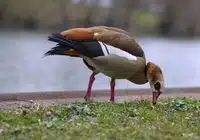
Researchers are investigating the feeding behavior and parasite fauna of invasive Egyptian geese.
By | October 5th 2026

The Egyptian goose, originally from Africa, is considered an invasive species of Europe-wide importance. Researchers from the Senckenberg Biodiversity and Climate Research Centre and Goethe University Frankfurt investigated the potential ecological and economic impacts of its spread over a period of four years. The analysis of 100 Egyptian geese from the Wetterau region reveals an opportunistic, predominantly plant-based diet and a surprisingly diverse parasite fauna. Seven… Read more »


Where maintenance costs breeding: Monotonous gardens contribute significantly to species loss + TIPS

By | April 18, 2026

The majority of gardens in towns and the countryside are species-poor and over-maintained: Monotonous lawns with minimal planting or even gravel offer our native songbirds neither enough habitat nor enough food. This becomes particularly evident in spring when robins and other birds are trying to raise their young. Even searching for a suitable nesting site consumes a lot of energy for the birds, and only… Read more »

Breeding season is predator season – but effective measures can protect nests

By | April 16, 2026

With the arrival of spring, the breeding season for native songbirds has begun in Central Europe. Many species have been laying their eggs since the end of March or beginning of April, including blackbirds, great tits, blue tits, robins, chaffinches, wrens, nuthatches, and dunnocks. During this sensitive period, the clutches and nestlings are particularly vulnerable – a problem that is exacerbated in gardens and residential areas by… Read more »

Brave ones lead, adventurous ones follow: New insights into the social roles of greylag geese

By | August 19, 2025

A study by the Konrad Lorenz Research Station for Behavioral and Cognitive Biology at the University of Vienna has found an explanation for why certain greylag geese (Anser anser) have more influence within their group than others. The researchers were able to show that bold, but not aggressive, geese often initiate collective movements, while inquisitive birds tend to follow them. This suggests an interplay… Read more »

Instead of singing: dippers communicate by blinking

By | August 18, 2025

In the noisy environments of fast-flowing streams, dippers don't rely on louder songs, but rather on visual signals, blinking their white eyelids more frequently. A study led by the Max Planck Institute for Biological Intelligence and Lancaster University shows how these birds flexibly adapt their communication to noise and the presence of other dippers, and provides one of the clearest… Read more »

Extreme heat kills tropical birds: Populations have fallen by a third since 1980

By | August 12, 2025

Tropical bird populations have declined by 25 to 38 percent since 1980 compared to a world without climate change; some species have even lost over 50 percent. According to a study published in Nature Ecology & Evolution, the cause is increasing heat extremes. The research, which involved the Potsdam Institute for Climate Impact Research (PIK), the University of Queensland, and the Barcelona Supercomputing Centre… Read more »

Osterode am Harz: Another violation of the Federal Nature Conservation Act

By | July 23, 2025

In Osterode am Harz, Göttingen district, Section 39 of the Federal Nature Conservation Act (BNatSchG) has been violated again: An area of ​​approximately 4.100 square meters between Seesener Straße and the Schachtrupp villa was completely cleared of bushes. Section 39 of the Federal Nature Conservation Act prohibits the severe pruning or felling of hedges, living fences, bushes, and other woody plants between March 1st and September 30th. [ Continue reading »]

Appetite for sour food gave birds a significant evolutionary advantage

By | June 20, 2025

Mammals avoid acidic foods, but many birds enjoy eating sour fruits. A new study shows that the acid receptors in birds are suppressed when they consume highly acidic foods. This inhibits the transmission of acid signals and thus increases tolerance. The study's findings suggest that the molecular evolution of acid receptors in birds played a key role in their evolutionary history and diversification… Read more »

Unexpected finding: Cooperation in foraging is beneficial for vultures

In a case study, researchers from the GAIA initiative modeled whether information exchange among white-backed vultures (Gyps africanus) offers more advantages than disadvantages to individual birds when foraging. They found that social strategies are generally more advantageous than non-social strategies, but that environmental conditions such as the density of vultures and carcasses in the landscape strongly influence which strategy is most effective… Read more »

Birds: Offspring from extra-pair sex are predominantly male + BACKGROUND

By | April 22, 2025

Many bird species are monogamous. However, genetic studies have shown that the social partner is often not also the genetic father of all offspring. Shifted sex ratios were found among the unpaired offspring. This was interpreted as evidence of adaptive sex assignment by females: if an unpaired partner exhibits high quality and this has a genetic basis, the fitness… Read more »
