
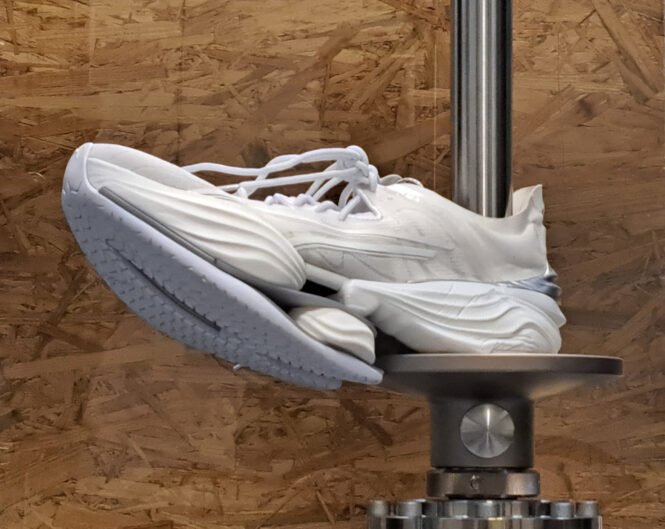
A research team from the Department of Biomechanics at the University of Bayreuth examined the soles of more than 100 running shoes. The results revealed that over a third of the soles had poorly designed heel areas, thus contributing to runners' risk of injury.
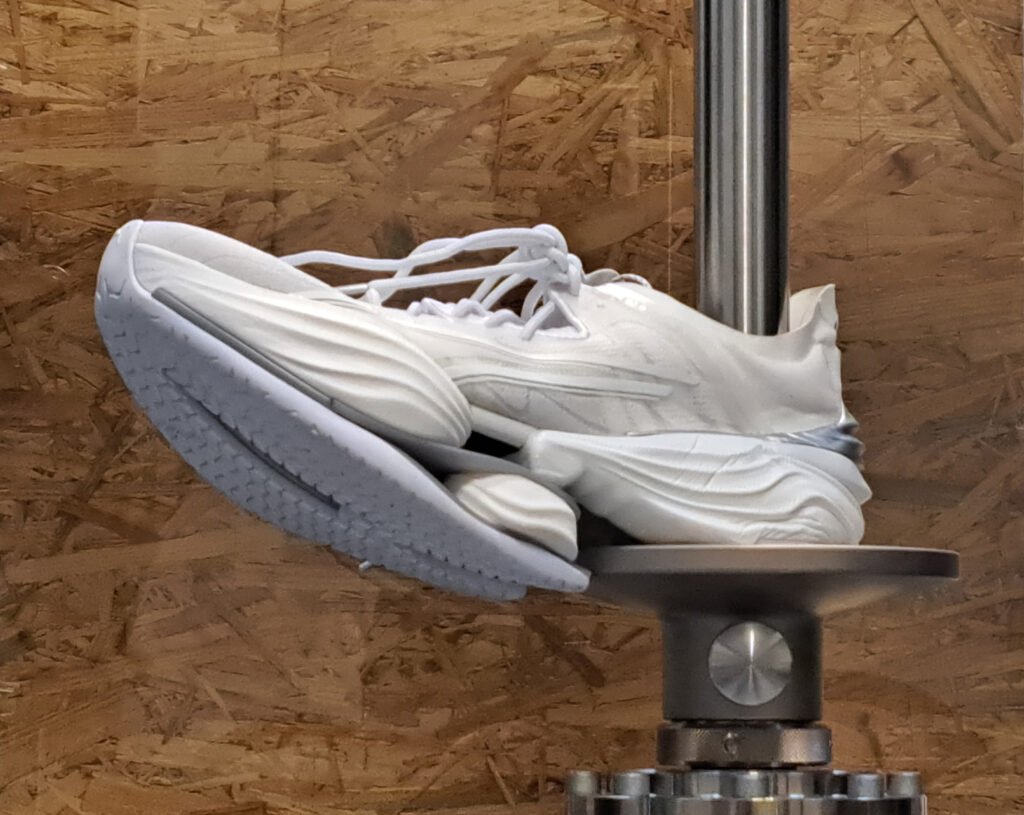
Sport is part of a healthy lifestyle and helps prevent chronic diseases. Running is one of the physical activities recommended by the World Health Organization and is extremely popular due to its ease of implementation: It requires no special sports facilities or equipment – except for running shoes. However, the running shoes must be designed to prevent injuries and chronic overuse syndromes. The injury rate among recreational runners, however, is around 45 percent per year. Running is therefore supposed to be healthy, but it also has the potential to cause health problems. Studies like those conducted by the Bayreuth researchers are helping to improve the design of running shoes and thus prevent injuries during sports.
The heel segments of running shoes are extremely important for cushioning. Well-cushioned shoes absorb the energy generated when you strike, preventing the leg from having to absorb this energy. This prevents overloading of muscles and joints. If the material of the heel segments compresses only slightly, the shoes feel hard due to the lack of cushioning. But material that is too soft can also feel hard when running, as the excessive material compression causes the heel to strike the ground, and you feel the ground. There should therefore be an optimal point between the two extremes where the heel is well cushioned. "The current standards for testing the heel segment of sprint shoes are not optimal, as they test the shoes with an energy absorption of exactly five joules. However, not everyone runs the same way, so not everyone produces five joules of energy with every heel strike," says Prof. Dr. Franz Konstantin Fuss from the Chair of Biomechanics at the University of Bayreuth and head of the study. He therefore believes that better methods are needed that are not based on rigid measurements.
Fuss, together with doctoral students Tizian Scharl and Niko Nagengast, has therefore developed a new testing system for measuring the properties of heel segments. This method calculates the ratio of absorbed energy to applied force and determines the so-called shoulder point, where this ratio reaches its maximum, i.e. where the most energy is absorbed with the least possible force. This maximum is ideal for shock absorption while running. Using four measurement parameters for the shoulder point, the Bayreuth researchers examined 112 running shoes from different manufacturers and classified them into three categories: over-engineered (too little cushioning because it is too hard, meaning too much force would be needed to achieve optimal cushioning), well-engineered (optimal cushioning), and under-engineered (too little cushioning because it is too soft).
Using their new method, the researchers discovered that 112 percent of the 38 shoe models tested were either over- or under-engineered. "These design flaws are obviously unintentional on the part of the manufacturers, as no optimal testing method was available until now. However, this also demonstrates that guidelines for the design and construction of heel segments are necessary to prevent injuries," says Fuss.
In addition, the study provides initial approaches for 3D-printed shoe soles in which the heel segments can be individually adapted to runners through simple and systematic design.
The study was carried out in collaboration with the Fraunhofer IPA – Applied Biomechanics Group and the sporting goods manufacturer Puma.
original publication
A New Method and Set of Parameters for Evaluating the Cushioning Effect of Shoe Heels, Revealing the Inadvertent Design of Running Shoes. Franz Konstantin Fuss, Tizian Scharl, Niko Nagengast. Bioengineering (2025)
also read
First coatings and textile samples made from renewable and recyclable materials | Pugnalom


