
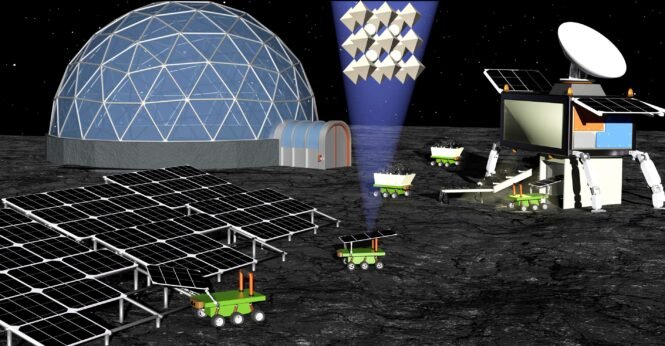
Transporting materials into space is extremely expensive – one kilogram to the Moon costs one million euros. Therefore, it makes sense to utilize resources available on-site. To this end, a research team led by Dr. Felix Lang of the University of Potsdam and Dr. Stefan Linke of the Technical University of Berlin combined lunar regolith with ultrathin perovskite to produce efficient lunar solar cells. This promising hybrid approach could enable the simple, scalable manufacturing of solar cells on the Moon to power future lunar habitats or even cities.
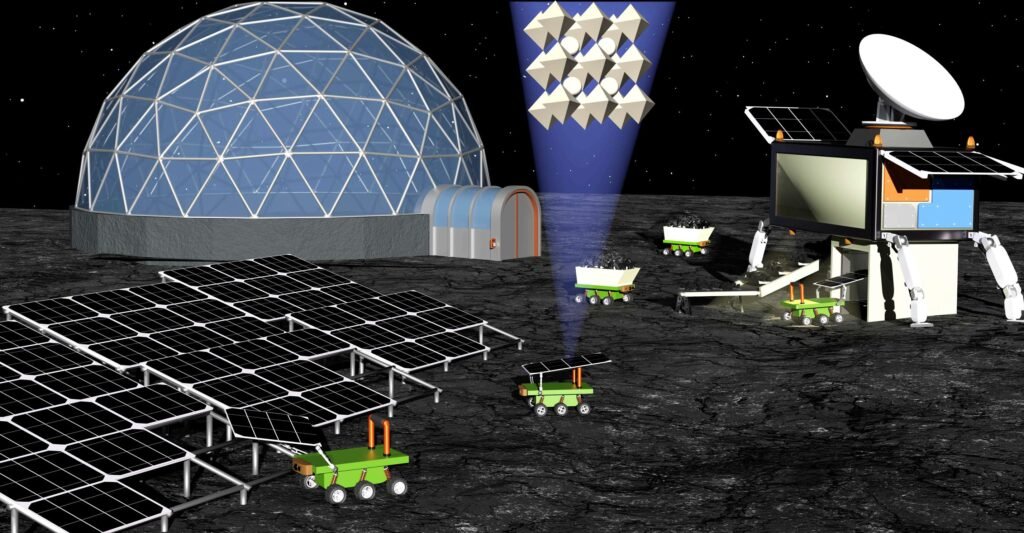
Future lunar settlements will require a great deal of energy. Since the Moon lacks an atmosphere, the sun is an ideal energy source for generating electricity from photovoltaics. In their study, Julian Mauricio Cuervo Ortiz from the University of Potsdam and Juan Carlos Ginés Palomares from the Technical University of Berlin, along with colleagues, investigated perovskite-based lunar solar cells that use regolith —an abundant raw material on the Moon—as a substrate for the photoactive layers. This eliminates the need to transport up to 99 percent of the weight of materials required to produce solar cells on the Moon. The two early-career researchers are the first authors of the article, which was published today in the journal "Device."
"The highlight of our study is that we can extract the glass required for our solar cells directly from the lunar regolith without any processing," says project manager Felix Lang, who heads a Freigeist junior research group funded by the VW Foundation at the Institute of Physics and Astronomy. "Furthermore, the process is scalable, allowing us to produce the solar cells with minimal equipment and very low energy input," he adds. The novel semiconductor material perovskite has the advantage that it can be extracted from a solution, is malleable, and is particularly resistant to radiation, light, and temperature fluctuations, which play a major role on the lunar surface.
Lunar regolith is a loose material ranging from broken rock to fine dust that covers the entire moon and was formed over billions of years by meteorite impacts. It consists primarily of SiO2, Al2O3, and CaO, with small amounts of metal oxides. Based on the composition of real lunar samples from the Apollo missions, a regolith simulation powder was produced at the Technical University of Berlin. When melted, it can be used to produce glass. Because the regolith composition varies depending on the lunar region, the glass can be lighter or darker in color. Accordingly, it is more or less transparent to sunlight.
The solar cells tested by the researchers have a layered structure, with the substrate and cover layer made of lunar glass and the intermediate layer made of perovskite. "These solar cells require semiconductor layers only 500 to 800 nanometers thick, so one kilogram of perovskite raw material from Earth could be used to produce 400 square meters of solar cells on the Moon," Lang summarizes. Nevertheless, the development of the first lunar perovskite solar cell was difficult: "Initially, it was unclear whether we could produce them with sufficient quality on impure regolith lunar glass," he says, emphasizing the astonishing stability of the solar cells produced against cosmic radiation—an essential prerequisite for a stable energy supply on the Moon.
original publication
Julián Mauricio Cuervo-Ortiz, Juan Carlos Ginés Palomares, Sercan Ozen, Enrico Stoll, Stefan Linke, Felix Lang, et al. (2025), Moon photovoltaics utilizing lunar regolith and halide perovskites, Device
also read
The “MoorPower” project investigates the effects of solar power on rewetted peatlands | Pugnalom
Smart innovation: Blinds darken and provide energy at the same time | Pugnalom


