
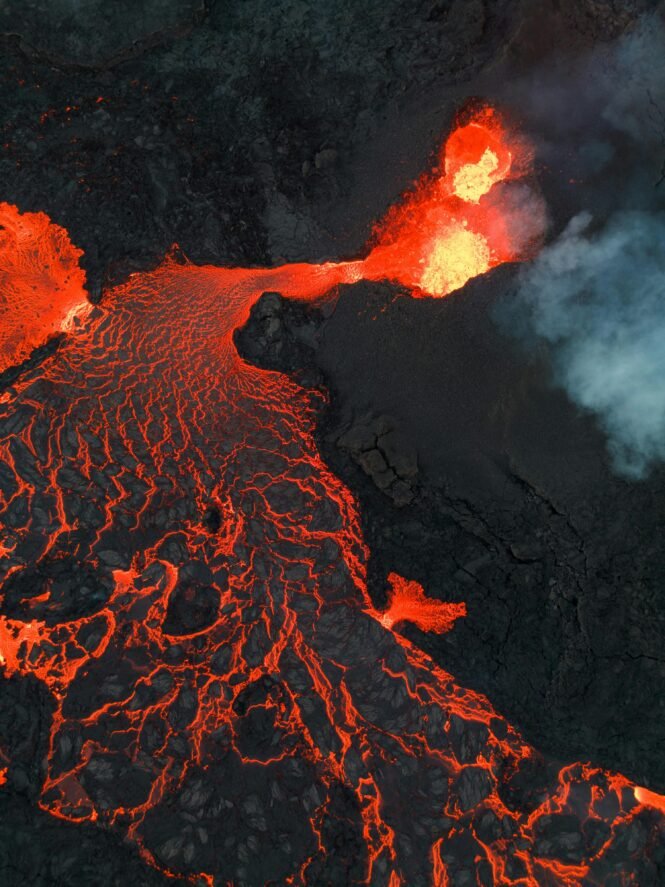
An international team of scientists has synchronized important geological climate archives from the Atlantic and Pacific Oceans with unprecedented precision. This allowed the researchers to decipher the chronological sequence of events during the last million years before the extinction of the dinosaurs at the Cretaceous-Paleogene boundary . For the first time, the geochemical data reveal when and how two major volcanic eruption phases, known as flood basalt events, influenced the climate and ecosystems in the late Maastrichtian period, 66 to 67 million years ago.

Over tens of thousands to millions of years, climate dynamics on the Earth's surface are determined by external and internal processes. From the Earth's interior, both heat and gas are released to the surface through volcanic eruptions. From the outside, quasi-periodic changes in the Earth's orbit control the amount and distribution of heat from the sun along the lines of longitude. These fluctuations, known as Milankovitch cycles, determine the duration and intensity of seasons on the Earth's surface. It is the interaction of these two processes, interwoven by complex geochemical interactions, that shapes and regulates the climate on our planet's surface.
"We use the rhythmic changes in solar radiation recorded in geological data like a metronome to synchronize the climate archives, i.e., to parallelize their temporal sequence. In our case, these are drill cores from seafloor deposits in the South Atlantic and the Northwest Pacific. The climate archives in the study span the last million years of the Cretaceous period and, thanks to our work, are now synchronized with each other with an accuracy of about 5.000 years or less. Geologically speaking, this is just a blink of an eye, extremely accurate for deposits formed 66 million years ago," says lead author Thomas Westerhold from MARUM - Center for Marine Environmental Sciences at the University of Bremen. This synchronization is essential for deciphering cause and effect in Earth's history between different regions. "Once we had perfectly dated the geological records, we could see that two major climate and biodiversity changes occurred simultaneously in both oceans. Now we had to find a way to test whether these changes were at all related to the Deccan Traps in India, which are witnesses to long-lasting and large-scale volcanic eruptions," says Westerhold.
The Deccan Traps, with their up to two-kilometer-thick basalt formations, cover large areas of western India. This extensive volcanism has flooded entire regions and is known by geoscientists as the "Large Igneous Province." Throughout Earth's history, these formations have repeatedly triggered mass extinction events on the Earth's surface. Researchers now believe that the release of volcanic gases such as carbon and sulfur dioxide during the formation of flood basalt likely played a crucial role in these events.
"The formation of flood basalts and their subsequent weathering leave a fingerprint in the chemistry of the oceans. Therefore, we looked at the osmium isotope composition in the South Atlantic and Northwest Pacific deposits. These should have the same osmium fingerprint at the same time," says co-author Junichiro Kuroda of the University of Tokyo, Japan, who conducted the geochemical analyses.
“To our surprise, we found two stages in the osmium isotope composition in both oceans that not only coincided in both oceans, but also coincided with the main eruption phases of the Deccan Traps basalts in the Upper Cretaceous. But even more surprising was that the two stages had different effects on the environment, as evidenced by fossil remains in the drill cores,” says Thomas Westerhold.
The new data were initially difficult to understand. But geochemical modeling helped to uncover their secrets. "For one thing, the amount of flood basalt in the early phase of Deccan Traps volcanism must have been greater than previously thought. For another, the data and models show that the flood basalt eruptions likely went through different phases, each resulting in varying levels of carbon and sulfur dioxide emissions. These then have different effects on the global climate system and organisms," says Don Penman (Utah State University, USA), who was responsible for the geochemical modeling.
According to the new discoveries, it seems plausible that at the beginning of the Deccan Trapp volcanism , which has been independently dated to 66.288 million years ago by radioisotopic dating, an initial pulse of sulfur-rich eruptions stressed the ecosystem locally and perhaps even globally.
About MARUM
MARUM gains fundamental scientific insights into the role of the ocean and the seabed in the Earth system as a whole. The dynamics of the ocean and the seabed significantly shape the entire Earth system through interactions of geological, physical, biological, and chemical processes. This influences the climate and the global carbon cycle, and gives rise to unique biological systems. MARUM stands for basic, open-ended research with a sense of responsibility to society, for the benefit of the marine environment, and in line with the United Nations' Sustainable Development Goals. It publishes its quality-assured scientific data and makes it freely accessible. MARUM informs the public about new findings on the marine environment and, through dialogue with society, provides actionable knowledge. MARUM's collaborations with companies and industrial partners are carried out in accordance with its goal of protecting the marine environment.
original publication
Thomas Westerhold, Edoardo Dallanave, Donald Penman, Blair Schoene, Ursula Röhl, Nikolaus Gussone, Junichiro Kuroda: Earth Orbital Rhythms links Timing of Deccan Trap Volcanism Phases and Global Climate Change. Science Advance 2025. DOI:10.1126/sciadv.adr8584


