
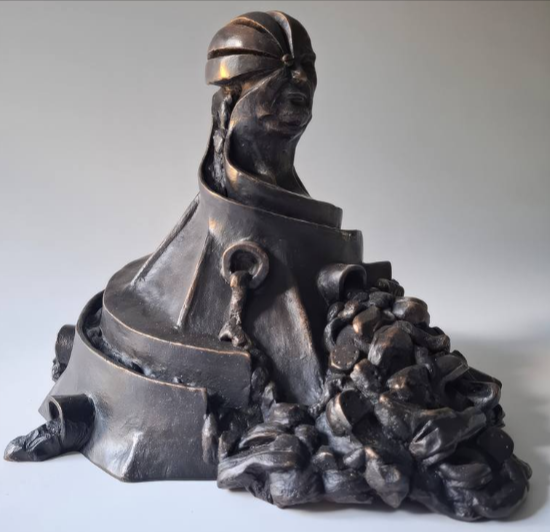
In the soft late-summer light of Tuscany, from 15 to 29 August 2026, the ninth Chianciano Biennale will unfold across the Chianciano Art Museum and the galleries of the medieval town centre. Among some three hundred international artists stands a compact bronze of unmistakable force: Marita Vollborn’s ARES. Cast in a limited edition of twelve, measuring roughly 34 by 29 by 30 centimetres, the figure was modelled in 2015 yet arrives with the unsettling currency of prophecy. It does not idealise the Greek god of war. It renders him as raw, unrestrained energy—bloodthirsty, merciless, perpetually seeking new victims—embodying not martial glory but the mechanisms that convert power, ideology and, above all, the greed for profit into organised destruction.
Vollborn, born in 1965 in Erfurt in the former German Democratic Republic, grew up under a regime that censored art, philosophy and free thought. She witnessed the peaceful revolution of 1989 and later worked as an investigative journalist exposing systemic failures in healthcare, food industries and politics before turning, around 2010, to sculpture. Her ongoing project Sinn und Scherben (“Sense and Shards”) comprises some fifty expressive figurative works in clay and bronze that probe human ambivalence: strength and fragility, power and guilt. ARES occupies the more confrontational end of that spectrum. “Art must not shy away from difficult truths,” she has said. “It is not a simple anti-war message, but an examination of the deeper mechanisms—the systematic exploitation of conflicts by the powerful.”
Three months before the American midterm elections of 3 November 2026, the sculpture addresses the American public with particular acuity. It does so not by lecturing from abroad, but by posing a question that cuts across partisan lines: Who actually profits? In a nation whose democratic self-understanding has long rested on institutional restraint, ARES crystallises anxieties about the erosion of checks and balances, the casual invocation of military options, and the return of great-power rhetoric that treats sovereignty as negotiable. Vollborn is explicit: the American people democratically elected their president; that outcome must be respected. What cannot be accepted, she argues, is the weakening of the very institutions that prevent any single leader or faction from acting without restraint—especially in international affairs. Discussions of territorial acquisition framed as dominance, or the open consideration of military pressure against sovereign territories, cross a line. Wars, and even the threat of war, remain unacceptable.
This stance is neither anti-American nor a conventional boycott. It is a deliberate withholding. Vollborn has stated that she is currently declining to exhibit ARES in the United States while those institutional safeguards appear unreliable and while open critical discourse feels unpredictably constrained. An empty pedestal, she notes, would itself constitute a statement—an absence that asks under what conditions critical art can still be shown. At the same time she welcomes American visitors to encounter the bronze in Chianciano, on neutral ground where the work can confront without being conscripted into domestic spectacle. The sculpture is anti-militarism and anti-greed, irrespective of origin.
American political art has long performed a similar dual function: mirror and warning. During the Vietnam era the Artists’ Tower of Protest (the Peace Tower) rose in Los Angeles in 1966—a collaborative scaffold hung with hundreds of panels by artists ranging from established figures to amateurs, a public refusal of official narrative. Nancy Spero’s War Series, Leon Golub’s confrontational figures of power, and the graphic interventions of the period insisted that aesthetic form could register dissent without surrendering to propaganda. Earlier, New Deal programmes treated public art as democratic infrastructure rather than private luxury, commissioning murals and sculptures that made visible social fracture and collective aspiration. Post-war sculptors such as David Smith wrestled with the nuclear age through monumental yet ambiguous forms; later generations contested monuments themselves, transforming symbols of martial or racial hierarchy into sites of critique. In each case the work did not merely decorate the public square; it tested the health of the institutions that claimed to protect free expression.
Vollborn’s refusal participates in that lineage. By keeping ARES on the European side of the Atlantic for the present, she refuses the decorative or legitimising function art can be pressed into when power seeks aesthetic cover. Yet by placing the bronze in the international, relatively independent setting of Chianciano, she extends an invitation: come and look. The compact, visceral mass of bronze does not offer consolation. It radiates the same ungoverned force that has, across centuries and continents, turned ideology and profit into suffering. More than eighty million dead in two world wars, she reminds us, proved insufficient to halt the arms race or the systematic exploitation of conflict.
In the weeks leading to the midterms, when American voters will again weigh the balance between executive energy and institutional restraint, ARES functions as a European contribution to a conversation that remains fundamentally American. It does not instruct the electorate how to vote. It asks whether the mechanisms that convert power into violence have been adequately checked, and who, in the end, profits when they have not. The answer, if it is to be written in anything other than blood, will have to be given by those who still possess the freedom—and the institutional architecture—to give it. In the hills of Tuscany the bronze waits, unyielding, for anyone willing to meet its gaze.